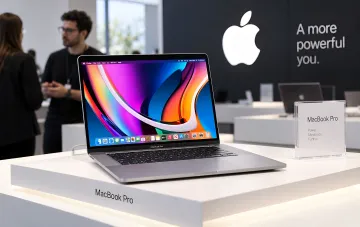
At an event titled 'Pro and tell', Apple officially introduced the new MacBook Pro, featuring the first touchscreen OLED display in the lineup's history. Announced on October 28, 2026, the launch stands as one of the most significant milestones in portable computer history: a device that would have seemed like a futuristic concept just a few years ago is now available for pre-order. Pre-orders opened on the day of the presentation, with official sales starting on November 6, 2026.
PROLED XDR: Touch Without Extra Layers
The main technological breakthrough of the new MacBook Pro is the OLED screen known as PROLED XDR. Unlike previous touch panel approaches where touch sensors were mounted as a separate layer on top of the matrix, the new device integrates touch elements directly into the display structure. According to Apple, this solution significantly reduces touch response latency, bringing the tactile experience closer to smartphones and tablets. Touch control is optimized for three key scenarios: working with iOS and iPadOS apps, navigating the macOS interface, and playing virtual musical instruments—the latter indicating that Apple views the touch MacBook Pro not only as a productivity tool, but also as a creative platform.
Thinner, Wider, Closer to 'Bezel-Less'
The new MacBook Pro features noticeably smaller bezels, allowing for an increased actual screen diagonal while maintaining overall body dimensions. The 14-inch model now boasts a true diagonal of 14.2 inches, and the 16-inch model measures 16.3 inches. In terms of thickness, the device has also become more compact: the 16-inch version shed nearly a millimeter, and the 14-inch version lost 0.5 millimeters. Despite Apple announcing M6-generation chips the very same week, the new touch laptop is powered by M5 Pro or M5 Max processors—a decision likely driven by the fact that the M6 is not yet fully ready for mass production in the portable segment.
From 'Ergonomic Nightmare' to Flagship Standard
The release of the touch MacBook Pro marks a radical shift in Apple's strategy, which for over a decade consistently rejected such a concept. Back in 2010, Steve Jobs publicly called touchscreen laptops an 'ergonomic nightmare,' and Tim Cook later compared trying to combine a tablet and a laptop into a single device to 'trying to cross a toaster with a refrigerator.' The company previously experimented with the Touch Bar, only to completely phase it out in 2023. Thus, transitioning to a full-fledged OLED touchscreen is not just a hardware upgrade, but an ideological turnaround: what was once considered a mistake has now become the flagship standard.
Pricing and Availability
The base 14-inch version of the new MacBook Pro with the PROLED XDR OLED display is priced at $2,899, while the 16-inch model costs $3,399. Pre-orders opened on October 28, 2026, the day of the announcement, and the first units will reach customers on November 6. Software preparation also deserves special mention: macOS 27.2 already contains hidden hints showing that Apple was working on touch MacBook support long before the official reveal.
Context: The First Major Redesign in Years
According to Bloomberg reports cited by industry outlets, the updated 14-inch and 16-inch MacBook Pro models have undergone their first major redesign in several years. The introduction of the Dynamic Island instead of the traditional notch, the transition to OLED, and the adoption of touch controls establish a new visual and functional language for the lineup. For the portable computer market, this means Apple is likely setting a benchmark that competitors will follow over the next two to three years: the OLED touchscreen is moving away from being a novelty to becoming an expected element of any flagship laptop.