Automotive giant Audi has officially acknowledged that the race to increase the number of touch displays in car cabins has reached its limit. Philip Brabec, Senior Vice President of Product Management at Audi of America, stated in The Drivecast podcast that controlling basic functions through multi-level screen menus is not always convenient for the driver, and the company intends to gradually bring back physical buttons, switches, and mechanical controls. "I think we went as far as we possibly could," Brabec summarized, summing up the multi-year trend toward interior "digitalization."
Who and how drove the cabin to "screen saturation"
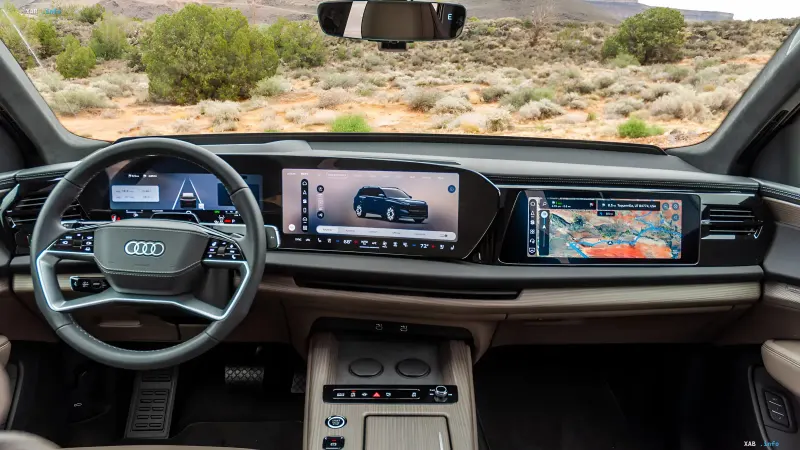
According to Brabec, the widespread adoption of touchscreen controls in cars was largely driven by two factors: pressure from the Chinese market, where local manufacturers were the first to experiment with giant multimedia panels, and the advent of electric vehicles, which were initially designed with a minimum of mechanical elements. As a result, the cabins of modern Audi models — such as the Q7 and Q9, whose interior is shown in the photo — feature three or more displays: the instrument cluster, the central screen, and a separate monitor for the front passenger. However, as the company itself admits, this approach has complicated the driver's daily interaction with the vehicle, especially when quick access to climate control or steering settings is required.
"Radical Next": a new design course emphasizing tactility
Audi is not stopping at a simple "rollback" to buttons. Together with designers Gernot Döllner and Massimo Frassella, the company is developing a new design direction called Radical Next. Its core idea is a more thoughtful and ergonomic layout of controls, simplified interiors, and the return of tactile feedback. As part of this course, Audi is considering the introduction of physical climate control buttons, redesigning the controls on the steering wheel and door panels so that the most frequently used functions are accessible without navigating through multi-level menus. At the same time, digital technologies will not be excluded: their role, in Brabec's words, is to simplify interaction with the car, not complicate it.
Changes will affect more than just future models
Importantly, according to Brabec, Audi intends to implement these new control organization principles not only in next-generation vehicles. The company plans to bring the updated interface logic to existing models in the near future as well. As an example, Brabec mentioned the solutions applied in the Q7 and Q9 — it is precisely in these cars, judging by the interior snapshot, that the three-screen configuration is already implemented, which Audi now intends to complement and, essentially, partially rebuild based on owner feedback. This means that owners of current model generations will be able to receive an updated set of physical controls through software and likely hardware updates.
Context: the industry is turning away from "glass" cabins
Audi's decision is not isolated. Amid growing criticism from drivers and automotive experts pointing to increased driver distraction caused by the need to search for functions in touchscreen menus, a number of other manufacturers have also begun rethinking their approach to cabin organization. Nevertheless, Audi has become one of the first major brands to publicly and so categorically acknowledge that the "screen race" has run its course. Brabec's statement in The Drivecast, made in November 2026, marks a turning point in automotive interior design: from digital panel maximalism to a balanced combination of displays and proven mechanical controls.