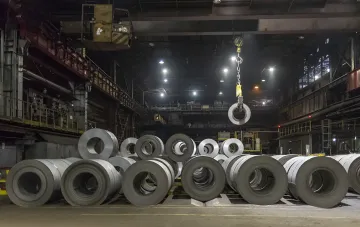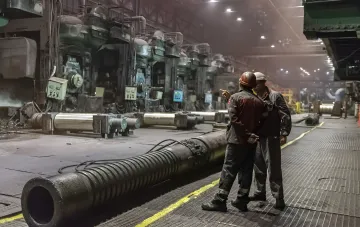
Ukraine's largest mining and metallurgical plant, ArcelorMittal Kryvyi Rih, is being transitioned into a cold shutdown mode. The decision was made following a series of massive missile attacks launched by Russia against the enterprise between August and October 2026. CEO Mauro Longobardo stated: "We have come to the conclusion that we cannot sustainably operate the enterprise and protect workers from the risk of further attacks." On September 25, 2026, the company informed the government of its inability to safely resume operations, and on October 10, it officially confirmed that the production process will not be restored until conditions allow it without unacceptable risks to personnel.
Chronology of strikes: from the first shelling to complete production shutdown
The enterprise suffered its first missile attack back in December 2022, when the strike hit the section rolling mill, killing one person and injuring three others. In April 2026, a drone strike killed one employee and hospitalized three others. However, the autumn campaign of 2026 became the turning point: according to the company, Russia launched 19 missile strikes against ArcelorMittal Kryvyi Rih from August to October. As a result, six people were killed, 28 were injured, and production facilities were severely damaged. Against the backdrop of these attacks, as well as strikes on other metallurgical enterprises in Ukraine, the plant in Kryvyi Rih proved unable to guarantee staff safety upon resuming work.
What cold shutdown means and what happens to the equipment
In cold shutdown mode, the company ceases primary steel production, and units operating at a minimum level are stopped in a safe and sustainable manner. The transition process will take several weeks. Once the shutdown is complete, the enterprise will determine how many workers need to be retained to maintain equipment integrity, viability, and preparation for future operations restart. The remaining employees will be placed on temporary leave. The company emphasizes that it does not plan to leave the Ukrainian market and is stopping operations only for the duration of the war: "When the war ends and conditions permit, we will engage with the Ukrainian government and reassess whether operations can be resumed safely and sustainably."
Economic significance of the plant for the country and the city
ArcelorMittal Kryvyi Rih is a single-industry enterprise for Kryvyi Rih and one of Ukraine's key industrial assets. The plant generates about 1% of the country's GDP, employs approximately 16,000 direct staff and tens of thousands more workers through the contractor chain, and is one of the largest exporters of metal products. Production shutdown means not only the loss of tax revenues for the budget but also a threat to local businesses dependent on the plant's orders. For Kryvyi Rih, which has lived off metallurgy for decades, this creates a risk of job cuts and lower population incomes.
Tax burden, salaries, and the issue of mobilization reservation
Under shutdown conditions, the company is forced to continue paying significant tax amounts without having production income. At the same time, the enterprise is obliged to maintain salary payments to employees, creating an additional financial burden. The issue of mobilization reservation adds special urgency: with a decrease in the enterprise's income level, workers may lose their deferral from mobilization, as the current economic reservation criterion is tied to revenue volume. The company points out that for critical enterprises affected by aggression, this criterion needs to be revised so as not to deprive people of protection during a period when they cannot influence production volumes.
Investment history: from a $4.8 billion acquisition to modernization
The acquisition of the former Kryvorizhstal in 2005 by Mittal Steel became the largest private foreign investment in Ukraine in the entire history of independence — the deal value was $4.8 billion, equivalent to 6% of the country's GDP at the time. In 2006, Mittal Steel joined the ArcelorMittal group, one of the world's largest steel producers. Since the acquisition, the group has invested between $6 billion and $11 billion in the modernization of the Ukrainian asset, according to various estimates: new continuous casting machines were installed, rolling mill No. 250-4 was modernized using equipment from the Italian company Danieli, new coke battery ovens were built, and dozens of gas cleaning plants were reconstructed and built. In 2025, the plant produced 1.7 million tons of steel. Analysts emphasize that preserving the production and personnel potential of the enterprise is critically important for Ukraine's post-war recovery, and this requires direct state support — including compensation for part of the payroll costs and a revision of tax obligations during the shutdown period.