
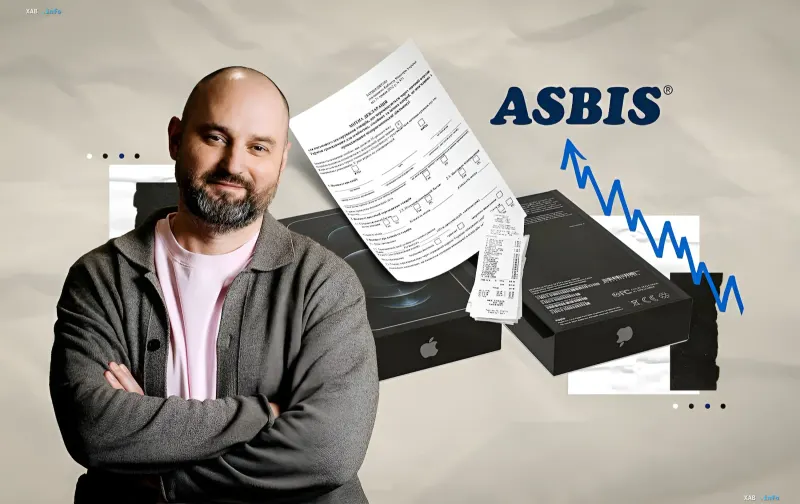
Ukraine's consumer electronics market is going through a gradual process of formalization, yet, according to the country's largest distributor, a significant portion of goods is still sold outside the authorized channel. ASBIS-Ukraine CEO Ivan Pavlik, in a special project by RBC-Ukraine, revealed that the share of official iPhone sales has grown from 20% to 40%, while around 60% of the market remains "in the shadows." In his words, this means billions in lost revenue for the state budget and the creation of an uneven competitive environment for legitimate businesses. The conversation also touched on how an IMEI-based device tracking system could change the situation, what role distributors, the state, and consumers themselves play in formalizing the market, and why modern distribution is far from simply "delivering goods to a store."
Official iPhone Sales: Doubled Growth, but the Shadow Sector Still Dominates
The key figure cited by Pavlik is the growth of the official iPhone sales share from 20% to 40% over recent years. This is undoubtedly progress, but, according to ASBIS experts, around 60% of the Apple smartphone market in Ukraine still operates in the unauthorized segment. Pavlik directly links this to two systemic problems: billions in lost budget revenue and a distorted competitive environment. Legal sellers, who pay taxes and provide warranty and service, are forced to compete with shadow channels that carry no such obligations. That is precisely why ASBIS advocates for the introduction of an IMEI-based device tracking system — a tool that, by design, should make the market transparent and strip unauthorized sellers of their competitive advantage.
Behind the Scenes of Apple's Autumn Launch: Synchronizing Dozens of Participants
Against the backdrop of the upcoming traditional autumn presentation of new Apple products, Pavlik described in detail what happens "behind the scenes" at a distributor during a major product launch. In his words, the process simultaneously involves the manufacturer, the distributor, retailers, banks, and service partners. The distributor's task is to ensure the synchronized operation of every link in this chain. During this period, ASBIS does not merely distribute goods: the company conducts demand analytics, assesses market capacity, designs marketing and credit programs, trains retailer teams, and builds out service infrastructure. The accuracy of these calculations determines supply volumes for the following weeks and months.
Particular attention deserves the point about Ukraine's alignment with the global launch calendar. If Apple's new products previously appeared in the country two to three months after the global launch, then in recent years Ukraine has entered the second wave of sales. Pavlik emphasizes: the faster the official product becomes available locally, the less room remains for unauthorized sellers, who have historically profited from the shortage in the first weeks after a presentation.
ASBIS's Portfolio: 90+ Brands and a Focus on Value-Added Distribution
Pavlik stressed that ASBIS-Ukraine is neither a single-brand nor an exclusively consumer-facing company. The distributor's portfolio includes more than 90 brands: from consumer electronics and computer components to server and network equipment, data storage systems, and engineering infrastructure. One of the actively developing areas is Value-Added Distribution, in which the distributor, together with integrator partners, builds comprehensive solutions: from a small server configuration to data center infrastructure. The logic here is the same as in the consumer business: create additional value around the technology, rather than simply selling what is in stock. According to Pavlik, a diversified portfolio makes the business more resilient, allowing it to work simultaneously with spot consumer demand and with the macro-trend of Ukrainian business digitalization.
Postwar Challenges: How to Keep Global Partners Aboard Amid War
Pavlik, who was working in retail at the time of the full-scale invasion in 2022, recalls the first months of the war: shipments effectively stopped, and for a global company watching news of a conflict of such scale, the most logical solution seemed to be minimizing risks and pausing operations. It was then that retailers and distributors jointly demonstrated to partners that the country was still alive: stores and e-commerce were working, and demand existed. Moreover, the argumentation was built not on words like "everything will be fine," but on specific figures and a detailed action plan — how to restore supplies and rebuild logistics. Pavlik calls this one of the key functions of Ukrainian business today — dispelling myths about the country with its own results and successes for global corporations.
Contradictory Data
All quantitative indicators cited in the interview — the growth of the official iPhone sales share from 20% to 40%, the 60% shadow market estimate, the billions in lost budget revenue — are internal assessments by ASBIS-Ukraine experts. No independent audit or confirmation of these figures by the state, Apple, or other market participants is contained in the provided sources. Moreover, ASBIS is an interested party in the discussion of market formalization: the more the market moves into the official channel, the more beneficial this is for the largest authorized distributor. This does not mean the data is unreliable, but readers should keep in mind that the source of the figures is the market actor itself, not a neutral analytical body. The RBC-Ukraine materials do not provide alternative estimates of the shadow segment's share, so comparing versions is currently impossible.