In August 2025, a scientific detective story unfolded in Earth's observatories. Astronomers directed NASA's most powerful radar systems toward a point in space where, according to calculations, a near-Earth asteroid was expected to appear. However, the object never showed up at the predicted location. This absence turned a routine observation into an investigation that ultimately overturned 28 years of study of this celestial body.
For a long time, the object designated 1998 SH2 was considered an ordinary asteroid. Scientists tracked its orbit from 1998 to 2016, observing two revolutions around the Sun. But in 2025, when researchers attempted to conduct additional observations using NASA's Deep Space Network, the calculations failed. The asteroid did not appear where gravitational models predicted it would.
The Mystery of Non-Gravitational Perturbations
The deviation from the trajectory became the key to the solution. Davide Farnocchia, a navigation engineer at NASA's Jet Propulsion Laboratory and lead author of the study published in Nature Astronomy, explained the situation as follows: "After we measured the non-gravitational perturbations affecting the motion of 1998 SH2 and realized they were incompatible with the object being an asteroid, we suspected we were looking at an active comet".
Ordinarily, asteroids move predictably, subject only to the gravity of the Sun and planets. However, 1998 SH2 behaved differently. Researchers hypothesized that the object might be generating a small thrust by ejecting gas into space. It was this subtle force that caused it to deviate from the calculated trajectory.
The Mystery of "Dark Comets" Unveiled
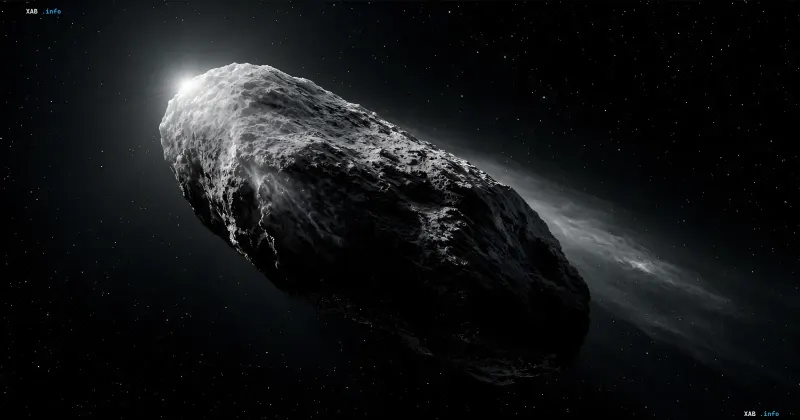
Comets are usually easily recognized by their characteristic tail and coma—a cloud of gas and dust surrounding the nucleus. But in the case of 1998 SH2, the amount of ejected material was so negligible that the tail remained invisible to most instruments. Such objects are called "dark comets": they look like asteroids but behave like comets.
To confirm the hypothesis, scientists conducted a large-scale observation campaign during the object's close approach to Earth in August 2025. Powerful telescopes around the world were deployed for this purpose: the 3.6-meter Canada-France-Hawaii Telescope in Hawaii, the 1.5-meter Danish Telescope in Chile, and the 8.2-meter Very Large Telescope of the European Southern Observatory (ESO).
The results did not keep them waiting. Olivier Hainaut, an astronomer at ESO and co-author of the study, noted: "Images collected from these observatories showed a faint but distinct tail, confirming that 1998 SH2 is indeed a comet. This is how science works—you formulate a hypothesis and go out to test it".
New Designation and Significance for Planetary Defense
As a result of the discovery, the object received a new preliminary cometary designation: P/1998 SH2. This is not just a name change—it is a fundamental shift in our understanding of its nature. The object passed at a safe distance of about 3 million kilometers from Earth, but its discovery has global significance for science.
The study sheds light on the enigmatic class of "dark comets". The authors believe that many of these objects may turn out to be ordinary comets with faint tails that were simply overlooked due to insufficient instrument sensitivity. This means there could be far more active icy bodies in the Solar System than previously thought.
Furthermore, the work highlights the importance of continuous tracking of near-Earth objects. Due to gas emission, the motion of comets is perturbed significantly more than that of asteroids. Detecting such perturbations can become an important diagnostic tool for planetary defense. Understanding whether an object is a comet or an asteroid is critical for accurately predicting its orbit and assessing the risk of collision with Earth in the future.