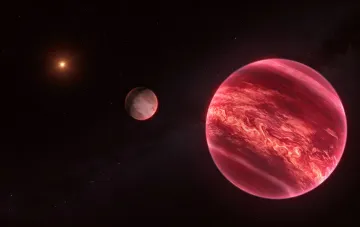
In the world of astronomy, a breakthrough is brewing that could revolutionize our understanding of cosmic systems. Scientists have discovered an object that is highly likely to be the first confirmed exomoon in history — a satellite orbiting a planet or another body outside the Solar System. However, despite the sensational nature of the discovery, the official designation of this object as an "exomoon" is being delayed due to the lack of clear classification criteria.
Details of the study, published in the prestigious journal Nature, are reported by RBK-Ukraine. The problem lies in the fact that while the definition of a satellite seems obvious within our Solar System, things are far more complex beyond its boundaries. Astronomers lack benchmark examples for comparison, as previously found candidates did not fit classical conceptions.
Lack of definitions and debates over status
The lead author of the study, astrophysics graduate student Kevin Hoy from the University of Diego Portales in Chile, directly points out the cause of the uncertainty. According to him, the absence of even a basic definition that would allow for a debate on criteria is the main reason why scientists cannot confidently claim the discovery of the first exomoon.
The discovered object represents the final component of a hierarchical system: a satellite orbits a body that, in turn, moves around a star. This is analogous to the Earth-Moon system, where the Moon orbits the Earth, and the Earth orbits the Sun. However, in this case, the satellite's "host" is not a planet, but a brown dwarf.
Brown dwarf as the "host"
A brown dwarf is a substellar object that lacks the mass to sustain hydrogen fusion. It is precisely this fact that causes disagreement within the scientific community. All known satellites in the Solar System orbit full-fledged planets. Consequently, there is no consensus among astronomers regarding whether brown dwarfs can be considered legitimate "hosts" for exomoons.
Furthermore, the size of the object is surprising. Although the mass ratio of the satellite to its host is only 2.5 percent, the satellite itself is only slightly smaller than Jupiter in terms of dimensions. This significantly exceeds the size of any known satellite in our Solar System.
Detection method: the Doppler effect
To identify the exomoon candidate, the team used the radial velocity analysis method, based on the Doppler effect and gravitational interaction between bodies. The essence of the method is as follows: when a satellite orbits its host, both bodies move around a common center of mass. This causes the "host" star or dwarf to wobble slightly.
"You can take this wobble, and if it results in changes in velocity towards you or away from you, you can detect this change over time to infer the existence of satellites orbiting the object you are observing," explained Kevin Hoy.
Astronomers monitored the brown dwarf from October 2023 to February 2026. Modeling allowed them to detect a signal from a satellite completing one full orbit around the host object every 170 days. This is the first time in history that such a technique has allowed for the detection of a brown dwarf satellite.
Future plans
The research is not yet complete. In the future, scientists plan to conduct an astrometric analysis to refine the mass and orbital angles of the discovered body. This data could be key to developing new standards for classifying exosatellites and, perhaps, finally resolving the debate over the status of the first exomoon.