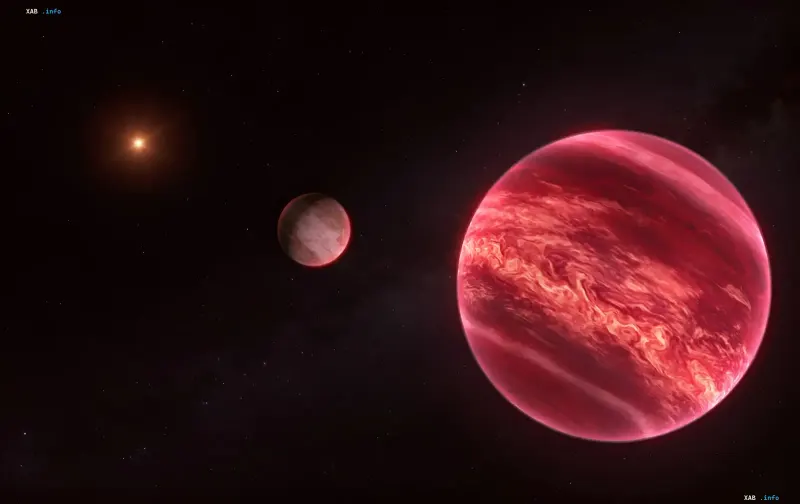
An international team of astronomers has made a unique discovery, identifying a mysterious cosmic object in the CD-35 2722 system, located approximately 73 light-years from Earth. The study, published in the reputable scientific journal Nature, has prompted scientists to reconsider conventional classifications of celestial bodies. At the center of this unusual system lies a star with a mass roughly half that of our Sun, orbited by a massive brown dwarf designated CD-35 2722 B.
The Essence of the Discovery and Radial Velocity Method
Brown dwarfs occupy an intermediate position between ordinary stars and giant planets because their interiors lack sufficient mass to ignite full hydrogen nuclear fusion. However, the primary sensation is that another mysterious companion has been discovered orbiting directly around this brown dwarf. To make this discovery, a research team led by Professor Kevin Hoy analyzed light spectra datasets collected using the powerful Very Large Telescope (VLT) in Chile between October 2023 and February 2026.
Scientists utilized the radial velocity method for the first time specifically to search for satellites around brown dwarfs. When a massive celestial body moves along an orbit, it exerts a gravitational pull on its host, causing it to periodically shift in space. Such micro-shifts are detected via the Doppler effect, which alters the light spectrum of the star or dwarf, allowing astronomers to calculate the presence of hidden gravitational companions even across vast distances.
Contradictory Data
Despite the high technological precision of the observations, certain scientific discussions persist regarding the nature of the discovered object. While some research groups classify it as a giant exomoon, other experts emphasize the need for further verification. Current data confirms only the gravitational influence of the object on the brown dwarf, while its exact mass and atmospheric composition remain debated. Due to the lack of established terminology for such rare cosmic configurations, researchers use the neutral term 'exomoon' while emphasizing the preliminary nature of their conclusions.
Analysis of Implications for Modern Astronomy
The discovery of such a non-standard hierarchical system poses new questions for astrophysicists regarding the formation mechanisms of planets and sub-stellar bodies. In our Solar System, moons orbit planets, and planets orbit the Sun following familiar dynamical laws. In the CD-35 2722 system, an object with the mass of a giant planet orbits a brown dwarf, which in turn orbits a star. Such complex architectures require a revision of existing cosmogonic models and long-term orbital stability monitoring to understand the evolution of similar exotic systems.