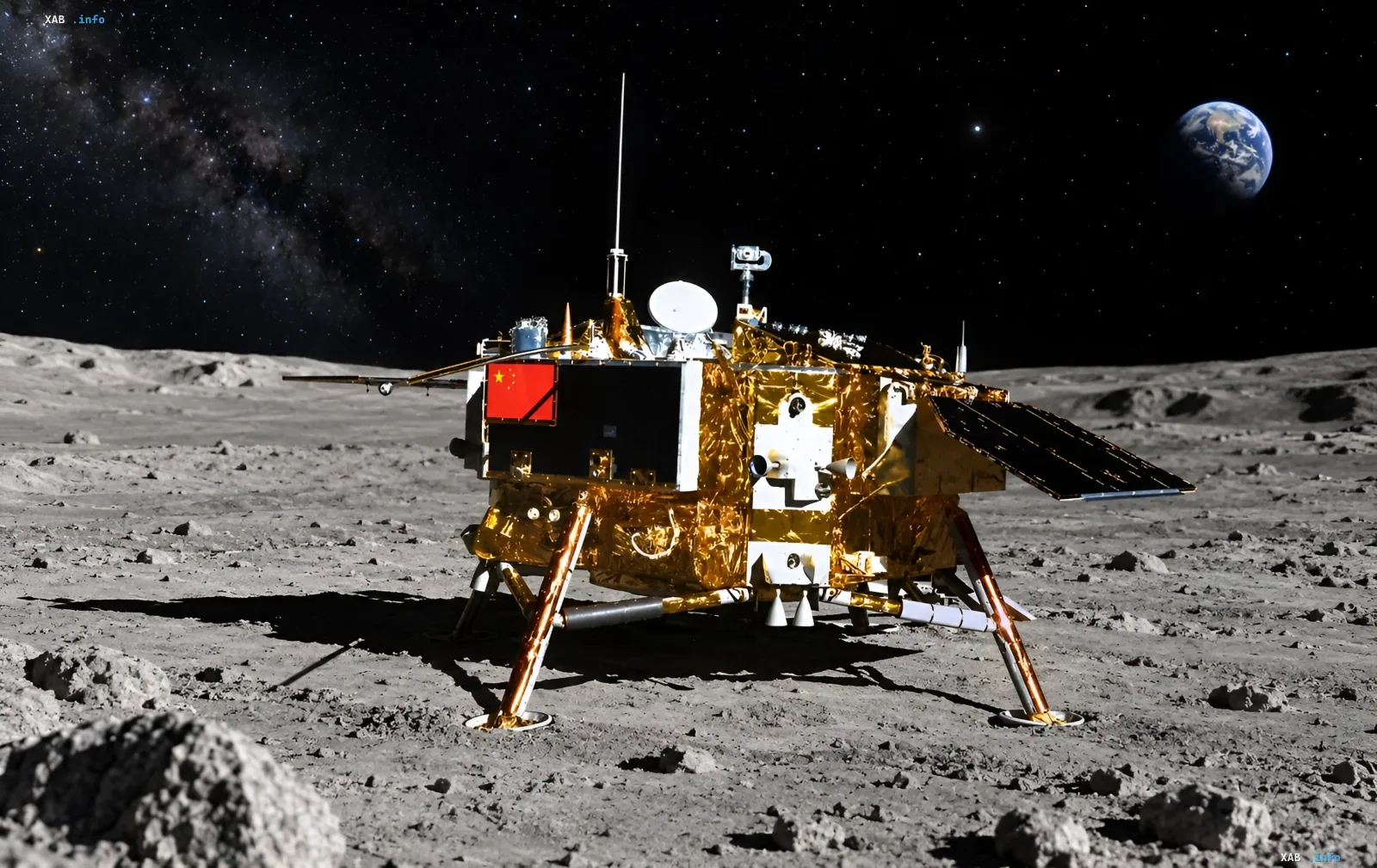
Analysis of lunar soil brought to Earth in 2024 by a Chinese interplanetary probe during the historic Chang'e-6 mission has led to a sensational discovery. Scientists found an anomalous and extremely rare form of iron within impact glass samples, which naturally forms only under extremely high temperatures. This finding forces a reevaluation of established views on the geological and physical processes occurring on Earth's natural satellite under external influences.
Background and the Mystery of Lunar Magnetism
Metallic iron is one of the key elements determining the magnetic properties of the lunar surface. Under standard conditions, atoms of this metal form a crystal structure that remains stable at temperatures below 910 degrees Celsius. There is also so-called gamma iron, which possesses a different spatial atom configuration, but upon normal cooling, it must transform into the familiar alpha phase. However, in samples retrieved from the giant South Pole-Aitken impact basin, researchers recorded the paradoxical stability of gamma iron nanoparticles at room temperature.
Space Physics of Extreme Conditions
As researchers discovered during a detailed study published in the peer-reviewed journal PNAS, the preservation of this unstable structure was made possible by a unique convergence of cosmic circumstances. When large meteorites impact the Moon's surface, colossal energy is released, causing instantaneous heating and tremendous pressure. Microscopic impurities of stabilizing elements, including carbon, enter this molten chaos. Subsequent ultra-fast cooling of the resulting impact glass literally "packages" and preserves gamma iron within microstructures, preventing atoms from rearranging into a stable state.
Controversial Data
It is worth noting that debates continue in the scientific community regarding the mechanisms of lunar rock magnetization and the scale of nanoparticles' impact on the satellite's general magnetosphere. While some researchers emphasize impact genesis and the role of meteorite bombardments, other physicists point to the potential influence of the ancient dynamo effect from the Moon's liquid core. Despite the absence of a global magnetic field in the modern era, new electron holography methods allow the recording of remanent magnetization, opening the field for new theoretical debates about the celestial body's past.
Expert Evaluations and Prospects
The application of advanced electron holography has enabled specialists to obtain direct images of the vortex ferromagnetic domain state of the discovered nanoparticles. This proved the ability of this anomalous iron form to reliably record and retain remanent magnetization across geological epochs. These findings provide scientists with a powerful tool to reconstruct the evolution of the Moon's magnetic field and study in detail the traces of ancient asteroid impacts that shaped our satellite billions of years ago.