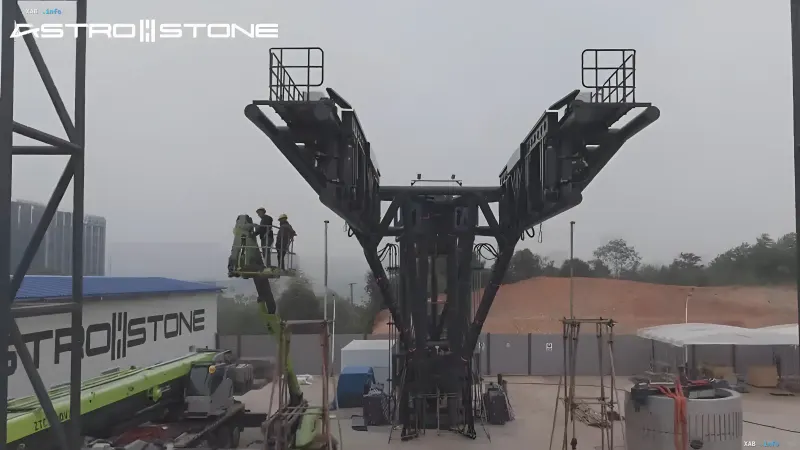
The Chinese company Astro Stone (also known as Yushi Space) has announced the successful completion of ground testing for a full-scale rocket stage capture and recovery system, dubbed the "chopsticks" in the industry. The installation, which visually resembles giant open jaws with protective rails at the ends of the manipulators, is designed to handle rockets weighing around 100 tons and is intended to refine the technology of stage recovery using capture manipulators—an approach already used in global astronautics, but one that Chinese engineers are implementing with their own unique design.
What is the 'Chopsticks' system?
The structure is designed as two symmetrical grasping arms that diverge from a common base and can close around a returning stage. The ends of the manipulators feature platforms with protective guardrails, while the frame itself is assembled from massive steel elements with hydraulic and cable lines visible on the housing. According to the developers, the system is designed for a specific class of launch vehicles—primarily the AS-1 rocket—and is intended to guarantee safe stage reception at full load under conditions closely approximating real launch scenarios.
How the tests went: over 100 days in extreme conditions
The ground testing program lasted for more than 100 days. During this time, the team tested the system in a wide range of conditions simulating a real rocket recovery mission profile: in rain, dense fog, strong winds, sharp temperature fluctuations, bright daylight, and low-light night conditions. A separate block of work involved checking the structural stability under dynamic loads and impact stresses simulating contact with a returning stage. Following the results, the company stated that the system confirmed its ability to operate under various weather conditions, at different loads, and in full-load mode.
Instrumentation: over 1,100 high-precision sensors
To monitor the tests, engineers utilized over 1,100 high-precision sensors that measured temperature, strain, displacement, acceleration, and various other design parameters. High-speed cameras were additionally used to record the dynamics of the manipulators' performance during the simulated capture. This set of measurements gives developers a complete picture of the system's behavior under load and serves as the basis for further refinement before moving to tests in conditions closer to actual launches.
The main goal of the technology — the AS-1 rocket
The capture technology is primarily being developed for the AS-1 rocket—a medium-class, two-stage launch vehicle approximately 70 meters long, with a launch mass of about 570 tons and a body diameter of 4.2 meters. The rocket uses a stainless steel body, liquid oxygen and methane engines, and a stage recovery system using a capture manipulator. In its expendable version, the AS-1 is designed to lift up to 15.7 tons to low Earth orbit, and up to 10 tons when reused, highlighting the economic viability of perfecting reusability.
Significance for the Chinese space industry
The completion of the 100-day ground testing program is an intermediate but important stage: it moves the capture technology from the design phase to a proven, measured, and verified stage in extreme conditions. For Astro Stone, this strengthens the company's position in the race for next-generation reusable launch vehicles, where the ability to reliably recover stages directly determines the cost of access to space. The next step will be the integration of the system with an actual rocket and tests in conditions as close as possible to the launch profile.