A team of astronomers led by University of California, Los Angeles (UCLA) researchers has announced the discovery of the first-ever "vanishing planet"—gas giant TOI-2535 b, located approximately 1,000 light-years from Earth. The study's findings are published in the scientific journal The Astrophysical Journal Letters. According to the researchers, this is the most extreme recorded example of planetary gravitational interaction to date, where a celestial body effectively "slips out" of telescopes' field of view right during a series of observations.
What is a "Hot Jupiter" and How Was It Tracked
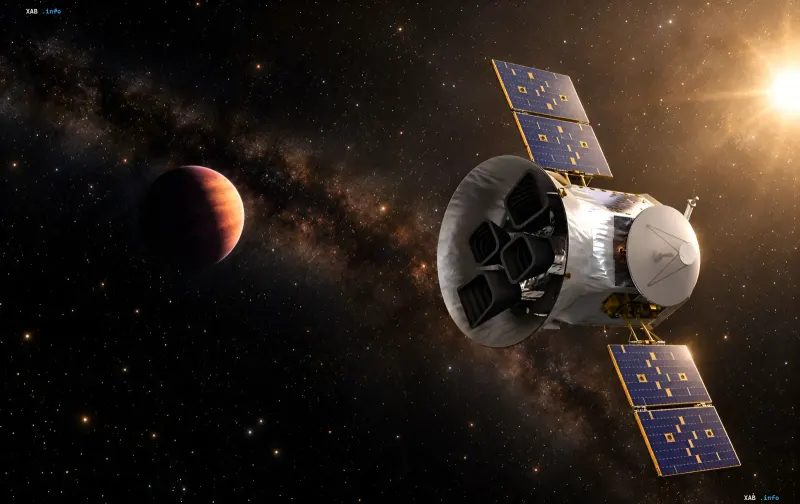
TOI-2535 b belongs to the class of "hot Jupiters"—massive gas planets orbiting at a very close distance to their star. The giant completes a full revolution around its star, or a planetary year, in just 8.25 Earth days. From April 2019 to March 2026, NASA's TESS space telescope consistently recorded the planet's transits—the moments when it passed in front of the stellar disk and partially blocked its light. It was these regular drops in brightness that allowed scientists to track the object and calculate its parameters.
Why the Planet "Vanished": Not an Explosion, but a Gravitational Shift
Analyzing the data, astrophysicists noticed anomalies in the celestial body's behavior: the transits stopped. The researchers proved that the planet did not explode or get ejected from the system. As it turned out, another massive planet with an inclined orbit orbits near TOI-2535 b. Their mutual gravitational influence "stirs up" their orbits, causing TOI-2535 b's orbit to shift and move out of the telescopes' direct line of sight. The planet continues to exist and rotate, but now it no longer passes directly in front of the star's disk from the perspective of an Earth observer—it has, in the scientists' words, "hidden."
When the Giant Will Become Visible Again
According to the authors' calculations, TOI-2535 b will next pass in front of its star only in 30–50 years, although its hidden neighbor might appear in the telescopes' field of view sooner. The researchers compare the effect to solar and lunar eclipses on Earth: they do not occur every month precisely because of the Moon's orbital tilt, and a similar orbital geometry makes TOI-2535 b's transits a rare event rather than a monthly occurrence.
What the Discovery Changes in Planet Formation Theories
The discovery also calls into question traditional views on the formation of "hot Jupiters." According to the classical model, such giants are born far from the star in ice-rich zones and then migrate inward. However, the presence of a neighboring planet and the perturbed orbit of TOI-2535 b point to a rarer, but no less interesting scenario—a slow forced drift during which the planets exerted gravitational influence on each other for a long time. The scientists emphasize that the recorded case has become a direct observation of this process and opens a new direction for studying the dynamics of multi-planet systems.