The European Southern Observatory (ESO) has launched the selection process for its next major ground-based astronomical project, following the 39-meter Extremely Large Telescope (ELT) currently under construction. The committee is considering several fundamentally different concepts ranging from an array of a hundred small telescopes to an optical interferometer with a baseline exceeding one kilometer. According to the developers, one option could eventually study exoplanet surface details, while another would simultaneously obtain spectra for 32,000 cosmic objects. Proposal submissions close on December 1, 2026, with the ESO Council expected to make a final decision in late 2028.
Spectroscopy for Thirty Thousand Objects
The first contender is the Wide-field Spectroscopic Telescope (WST), a 12-meter mirror telescope whose main task is not just discovering stars and galaxies, but analyzing their light. Spectra allow scientists to determine the chemical composition, distance, and physical properties of objects. WST is planned to be equipped with a system capable of simultaneously collecting and splitting light from 32,000 sources. Such an instrument will complement large-scale sky surveys conducted by the Vera C. Rubin Observatory and the Nancy Grace Roman Space Telescope: they discover a large number of new objects, but detailed study of many requires spectroscopy.
One Hundred Telescopes and Artificial Intelligence
The second project, the Time Domain Telescope, proposes creating an array of 100 telescopes, each 2 meters in diameter, capable of independently observing rapidly changing phenomena: stellar flares, neutron star mergers, and black holes tearing apart stars. The system will be able to distribute observations among dozens of events simultaneously or focus on a single faint object. To manage the array and redirect telescopes to new targets in less than a minute after receiving an alert about an astronomical event, the project plans to incorporate artificial intelligence.
Millimeter Range: ALMA Expansion or a Single Giant
Two further proposals involve observations in the millimeter and submillimeter ranges. The ALMA2040 project envisions expanding the existing ALMA complex with several hundred new antennas, allowing for more detailed studies of gas and dust in protoplanetary disks and galaxies. An alternative option, the Atacama Large Aperture Submillimeter Telescope (AtLAST), is a single 50-meter single-dish radio telescope: thanks to its wide field of view, it will be able to systematically map cold gas and dust, including within the cosmic web filaments connecting galaxies.
Kilometer-Scale Interferometer and Exoplanet Vision
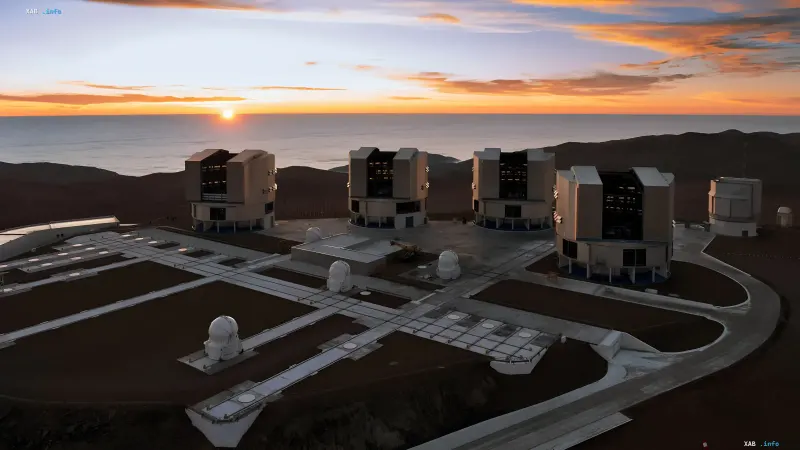
The most unusual concept involves building an optical interferometer from telescopes separated by 1 kilometer or more. An interferometer combines data from multiple instruments to achieve a resolution corresponding to the distance between them. Such a system could study matter in the immediate vicinity of the supermassive black hole at the center of the Milky Way and potentially discern surface features on exoplanets. However, kilometer-scale optical interferometer technology is not yet sufficiently mature, so its implementation carries significant technical risks.
Timeline and Decision-Making Process
According to Paul Callanan, head of the astronomers' committee, at least 10 teams could prepare final designs over the next year. The committee will issue a recommendation, and the final decision will be made by the ESO Council in late 2028. Meanwhile, the ELT under construction, set to become the world's largest optical telescope, is scheduled to begin operations in 2030 — meaning the successor will be chosen just as the 39-meter giant starts delivering its first scientific results.