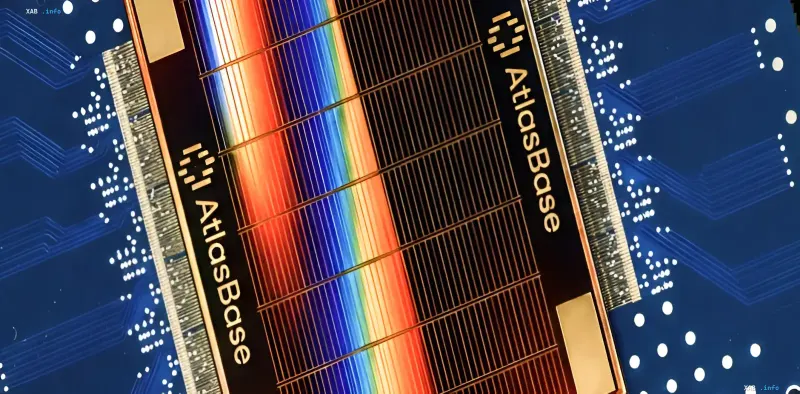
AtlasBase has taken a major step forward in the information technology sector by announcing an innovative platform for molecular computing. At the core of this development is the latest patented CMOS chip called Thalia, which unlocks the ability to create synthetic DNA at an unprecedented petabyte scale. The integration of biosilicon layers and electrochemical synthesis methods directly into the semiconductor architecture has allowed for 5.6 billion electrochemical synthesis sites to be placed on a single chip. This outperforms previously available solutions by 700 times, effectively overcoming a key technical barrier for the advancement of molecular computing.
Architecture and Principles of Molecular Memory
The need to introduce fundamentally new data storage media is driven by the explosive growth of generated data against the backdrop of global artificial intelligence development. The AtlasBase platform aims to seamlessly complement existing silicon infrastructure by utilizing synthetic DNA not only for archival storage, but also for performing computations directly within working memory. A software codec converts standard digital files into amino acid sequences of A, C, T, and G. The resulting code is sent to the biosilicon matrix, where exact DNA copies are created using the polymerase chain reaction (PCR). Once synthesis is complete, the biomaterial is dehydrated and placed in hermetically sealed stainless steel capsules for long-term storage.
Scalability and Economic Efficiency
The creation of the Thalia chip using existing mass-production semiconductor technologies opens realistic prospects for the commercial deployment of molecular infrastructure into enterprise-level data centers and hyperscaler projects. The platform provides record-breaking storage density: petabyte-scale data arrays are compactly housed in capsules measuring just 7 by 18 millimeters. System capacity starts at 100 TB per footprint unit with the ability to scale up to an impressive 5 EB in identical dimensions. Expert evaluations by Blocks & Files confirm that these figures surpass the capacity of modern LTO magnetic tapes by an order of magnitude at identical equipment dimensions.
Expert Evaluations and Application Prospects
Former Sony Pictures Entertainment CTO Bill Baggelaar emphasized the strategic importance of the development, noting that AtlasBase goes far beyond classical archiving. The company is effectively transforming DNA into a universal molecular environment capable of simultaneously storing information and performing complex computational operations. Currently, AtlasBase is launching early access programs for strategic partners. Promising areas of application include media, financial services, logistics, scientific research, and large-scale corporate archiving.
Contradictory Data
While official AtlasBase technical specifications claim unprecedented data storage densities of up to 5 EB per standard footprint unit and a 700x scale-up in synthesis compared to previous chip generations, independent expert communities continue to analyze real-world metrics regarding durability and biomaterial readout speeds in commercial data center environments. Some analysts point to potential limitations of commercial sequencing during massive daily access to petabyte archives, emphasizing that the technology is still in early access and requires comprehensive validation under real-world enterprise system conditions.