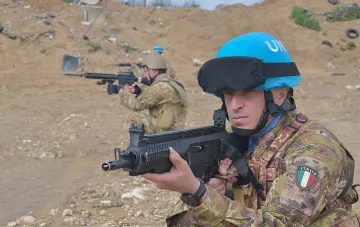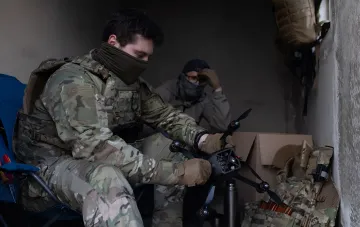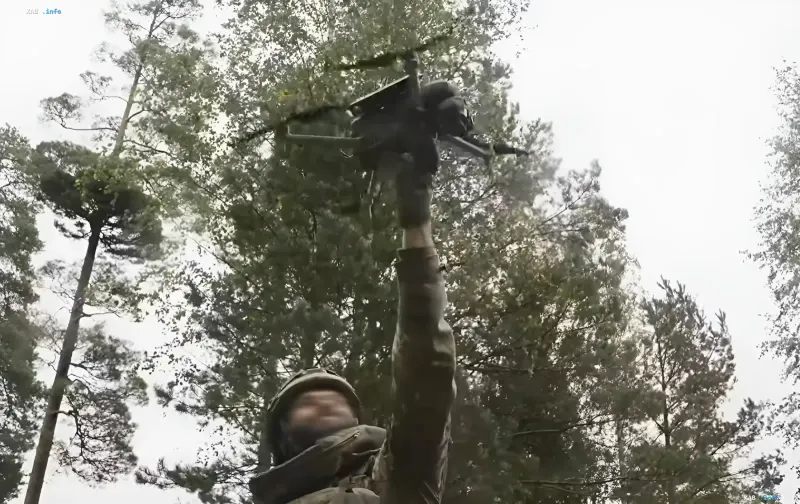
Fighters of the 12th Special Purpose Brigade "Azov" of the National Guard of Ukraine underwent three days of joint training with soldiers of the Latvian National Guard as part of the annual nationwide exercises NAMEJS 2026. This was reported in a press release from the brigade, which was relayed by the publication RBC-Ukraine. Soldiers from Sweden, Denmark, and Lithuania were also involved in the exercises, turning the maneuvers into a multilateral practical seminar on integrating unmanned technologies into the defense doctrines of the Baltic and Northern European countries.
Role of the Ukrainian unit: from FPVs to ground robots
During the exercises, Azov fighters served as an allied unmanned systems unit, subordinate to the 1st Riga Brigade of the Latvian National Guard. The Ukrainian group included crews of FPV drones, Mavic multicopters, and heavy "bombers," as well as operators of strike and reconnaissance ground robotic complexes (GRC) and a separate command group. This configuration allowed Latvian colleagues to observe the full cycle of a reconnaissance-strike loop—from data collection to precision strikes—in conditions as close to combat as possible.
Reconnaissance-strike complex practice
The main goal of the Ukrainian unit's participation was a practical demonstration of how a reconnaissance-strike complex using unmanned systems functions in modern warfare. Notably, ground robotic complexes and heavy drones became a key element of the scenario: Latvian military personnel had the opportunity to witness the tactical characteristics of platforms that Ukrainian forces have been using en masse on the front line for over three years. Previously, on October 21, the Ground Forces of the Armed Forces of Ukraine demonstrated how wheeled GRCs install wire obstacles on the front line, controlled by an operator from a safe distance—and this experience formed the basis of the Latvian maneuvers.
Latvian command assessment
Commander of the 1st Riga Brigade of the Latvian National Guard, Lieutenant Colonel Eriks Keisters, emphasized in his commentary at the end of the training that Latvian military personnel can learn a lot from their Ukrainian colleagues. "I believe we can learn a lot from you. One of our main tasks is the defense of the Latvian capital, Riga. We are also interested in your technical mastery in using drones," he stated. These words signal a shift in Baltic tactical doctrine: while the focus was previously on classic infantry defense, unmanned systems are now becoming a priority area of training.
Significance for allied cooperation
The press service of the 12th "Azov" Brigade emphasizes that participation in such exercises testifies to the recognition of the professionalism of Ukrainian soldiers, who are sharing their practical experience in countering Russian aggression with allies. For Latvia, whose capital Riga is in the potential threat zone, the opportunity to work side-by-side for three days with a unit that has direct combat experience in using drones and GRCs is of high operational value. The NAMEJS 2026 exercises thus moved beyond national maneuvers to become a platform for transferring advanced unmanned warfare tactics into NATO defense practice.