
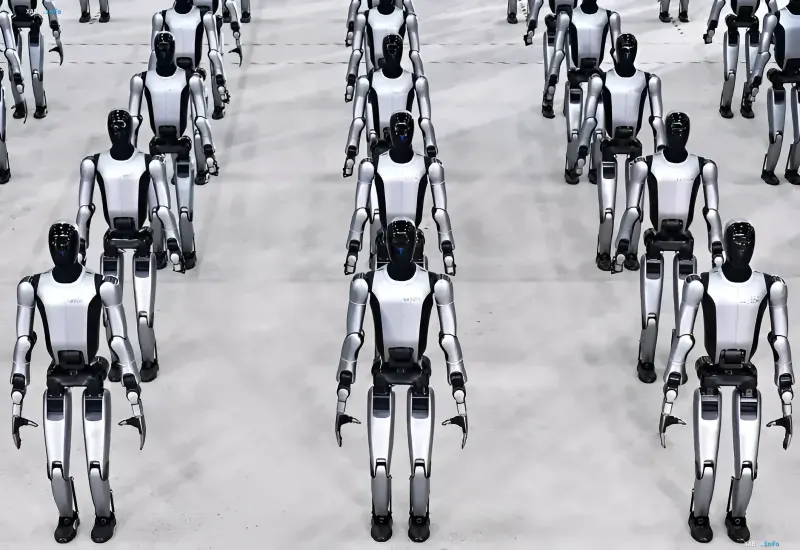
In August 2026, against the backdrop of escalating geopolitical tensions and a technological arms race, an initiative is gaining momentum in the US Congress to impose a complete ban on the import of robotics products manufactured in China. This step, aimed at protecting national security and stimulating local production, has already been subjected to detailed analysis by the authoritative research firm IDC. The study results indicate that the consequences for the global market will be less dramatic than expected, and the redistribution of supply flows could prove beneficial for the European region.
Technical Nuances and Business Model Adaptation
IDC specialists clarify the key details of the potential embargo: the ban will likely apply only to new robot models developed in the future. Devices already supplied to the US market will be able to continue operating and receiving maintenance, provided their production is not discontinued by suppliers. Furthermore, Chinese companies will retain the ability to improve the software of existing models, expanding their functionality within certain limits. However, the business model familiar to Chinese giants, based on the rapid replacement of device generations, will cease to work in the US. Manufacturers will have to radically adapt their strategies, focusing on long-term support for current versions rather than aggressive marketing of new releases.
Market Geography: Why the US Is Not the Only Player
Analysts emphasize that the US, despite its economic power, accounts for only 18% of global robotics consumption. China remains the largest market with a 21% share, but the overwhelming majority—61%—is realized in other regions. In particular, Europe accounts for twice the consumption of robotic products compared to the US. This means that a partial closure of the American market will not be a fatal blow for Chinese suppliers. On the contrary, export flows will be redirected to the Old World, where the market is economically more attractive than the domestic Chinese market, which suffers from high price competition.
Loss Forecast and Market Segmentation by 2030
Even with the introduction of strict restrictions, the growth of the robotics market in the US will not stop completely. According to IDC forecasts, the country will shift from a baseline scenario with an average annual growth of 13% to a more conservative figure of 9%. Nevertheless, between 2026 and 2030, the US market could lose up to $6 billion in revenue, with more than $2 billion falling at the end of this five-year period. The difference in supply volumes between the ban and non-ban scenarios will vary by segment: in home robots, it will be 18%; in industrial and retail sectors—43%; and in the humanoid robot segment, losses could reach 58%.
Crisis in Humanoid Robotics and Import Dependence
The situation is most critical in the segment of humanoid robotics. Chinese suppliers currently account for 82% of the global market. The problem is that American manufacturers will not begin mass supplying their analogues to the market until the end of 2028. This creates a dangerous time gap: without Chinese imports for two years, American buyers and businesses will find it extremely difficult to solve tasks requiring the participation of humanoid robots. Unlike industrial machines, which can be produced locally with subsidy support, home robots are unlikely to be manufactured in the US due to economic impracticality, and they will continue to be exported from China.