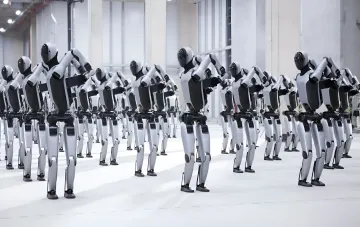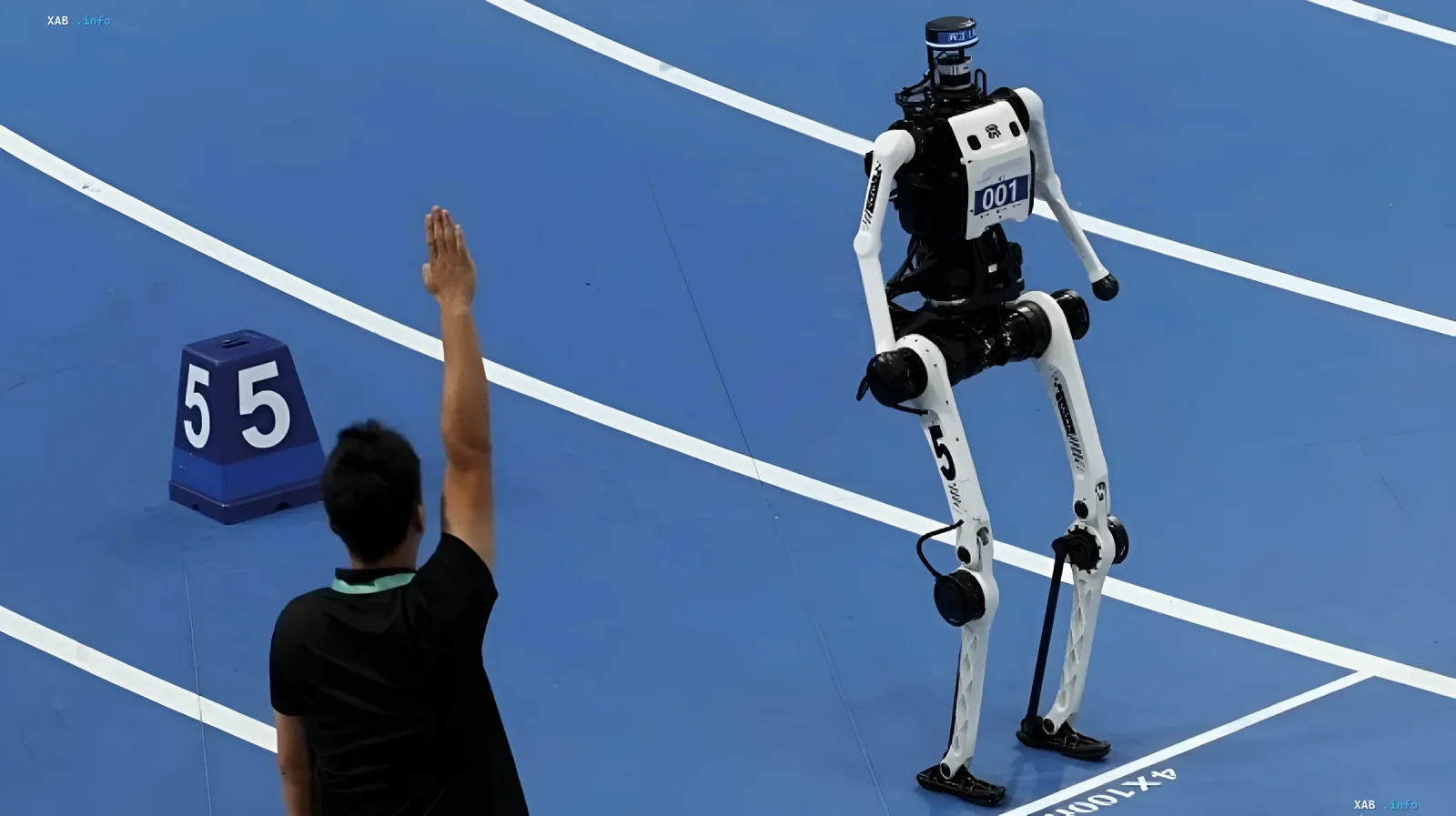
On the first day of the World Humanoid Robot Games, Chinese humanoid robots set a new benchmark in the 100-meter sprint, surpassing Usain Bolt's world record time (9.58 s). The race on the blue track with white lane markings drew attention not only for its speed but also for the scale of the event, where the robots competed under conditions close to a real athletics track.
Home straight: who took the gold
The winner of the first day was Tiangong Ultra, developed by the Beijing Center for Humanoid Robotics Innovation. Trailing at the start, the robot caught up and passed Lightning right at the finish line, stopping the clock at 9.39 seconds. Lightning finished second with a time of 9.47 seconds — a result that is also faster than Bolt's record.
Progress over a year
The 9.39-second mark far exceeds last year's result by the same Tiangong Ultra, which then covered the 100 meters in 21.5 seconds. Tiangong also won the world's first half marathon involving humanoid robots, held in Beijing, last year. This year, Lightning won the half marathon with a time of 50 minutes 26 seconds — faster than the world record of the best male athletes.
Contradictory data
Earlier the same day, Chinese state media reported that Lightning posted 9.32 seconds in a test run, reaching a top speed of 14.5 meters per second. This test time turned out to be faster than both official race results (9.39 and 9.47 s), raising the question of whether the test run conditions matched the official race regulations. In addition, a number of headlines present the achievement as the result of a single robot, whereas in the official race two machines finished ahead of the 9.58 s mark.
Scale of the championship
The 100-meter race is just one of the 51 events at this year's championship, alongside football, dancing, and industrial trials. A total of 2,056 robots from 666 teams in 16 countries took part, a significant increase over the 280 teams at the first championship. The Lightning robot stands 1.69 m tall with a leg length of 95 cm; according to CCTV, before the tournament researchers extended its legs by another 10 cm — to 1.05 m.
Strategic context
China regards humanoid robots as a strategically important emerging industry, expecting that advances in artificial intelligence and hardware will accelerate the deployment of robots in manufacturing, logistics, and the consumer sector.