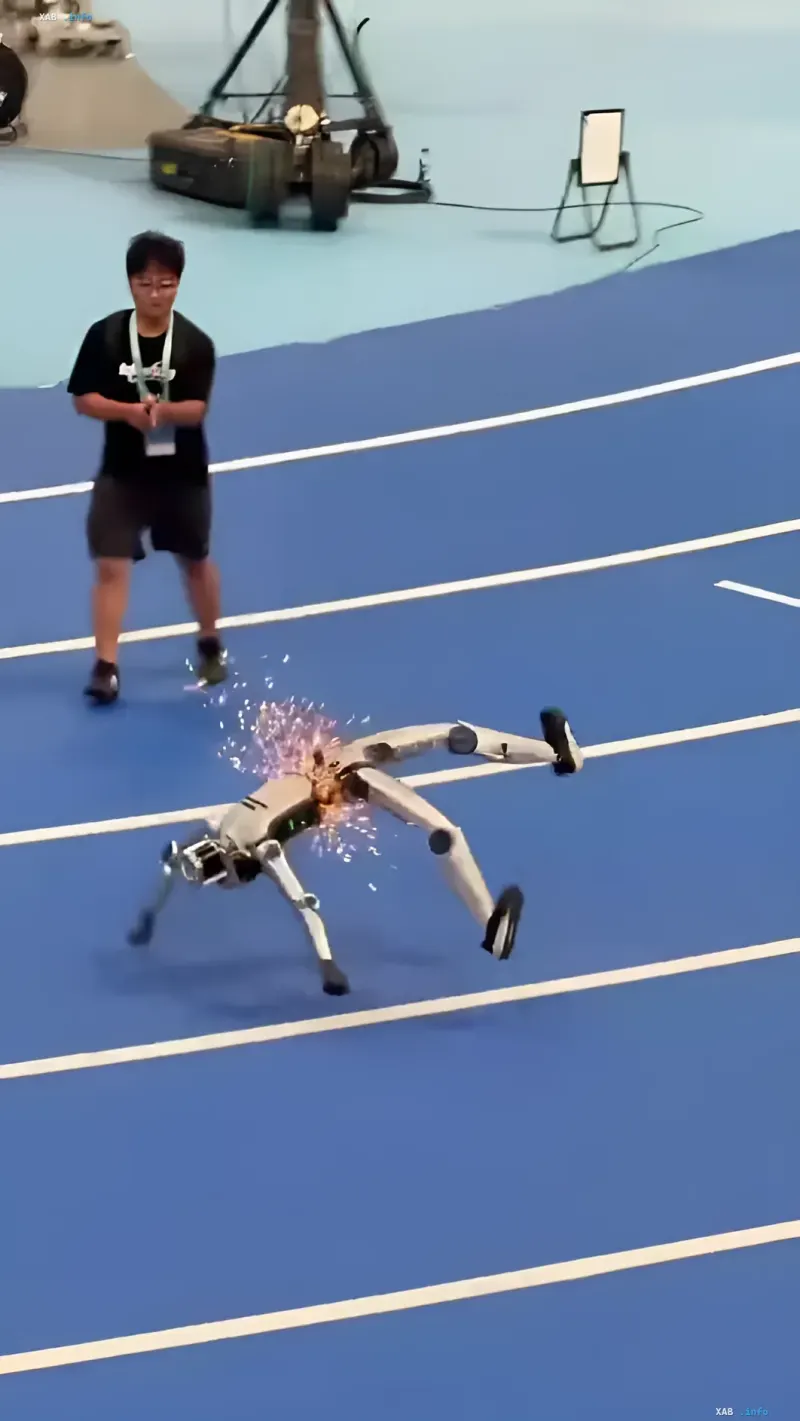
In Beijing, on the eve of the official start of the World Humanoid Robot Games 2026 (informally known as the 'Robot Olympics'), an incident occurred that instantly went viral online. During a training sprint on a closed track, a bipedal sprinting robot failed to brake in time and crashed at full speed into a protective soft mat, literally folding in half at the waist. The footage of the crash was dubbed the first 'sports injury' in the history of robotics.
Chronicle of the incident
The published recordings show the humanoid device racing down the running track at an impressive speed. However, as it approached the turn and the end of the distance, the braking algorithm failed: the machine did not slow down or correct its trajectory, slamming into the foam safety wall. From the dynamic impact, the load-bearing structure could not withstand the colossal force — the robot folded in half at the lumbar joint, sparks flew from the damaged compartment, after which the device collapsed onto its back. According to engineers, restoring the servos and fasteners will take a long time, which effectively rules out this model's participation in the tournament. On social media, the incident instantly spread into memes: users joked that the android 'pulled its back', 'tore its cruciate ligaments', or 'broke its own HDMI cable'.
Games at the edge of capabilities
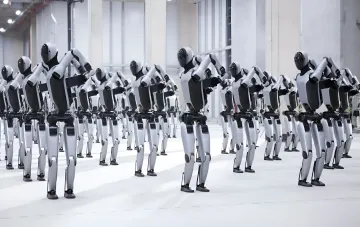
The competitions in Beijing, taking place from August 22 to 26, 2026, brought together more than 2,000 androids from 666 teams, competing in more than five dozen disciplines — from sprint, football and boxing to gymnastics, table tennis and even household tasks. In parallel with the falls and breakdowns, other humanoids demonstrated fantastic progress: one of the sprinters covered 100 meters in a record 9.32–9.39 seconds, surpassing Usain Bolt's world record (9.58 sec.), and in the high jump the bar was raised to 2.88 meters. Thus, the 'Robot Olympics' became both a showcase of technological breakthroughs and a clear demonstration of their limits.
Analytics: the braking barrier in robotics
The curious accident clearly illustrates the main 'bottleneck' of modern sports robotics. Neural networks trained by reinforcement learning have learned to accelerate a metal skeleton weighing dozens of kilograms to the speed of professional athletes, however, managing kinetic energy and balancing the center of gravity during sharp deceleration remain the most complex engineering problem. The mass of the batteries and drives in the upper part of the body creates a huge overturning moment during braking, and the limited grip of the feet does not allow developing reverse traction. Unlike a human, whose muscles dissipate speed in eccentric mode, the robot's electric drives are overloaded, and the sensor delay makes the machine 'run' even at the moment of collision. The ability to stop in time turned out to be a far more difficult task for artificial intelligence than running at top speeds.