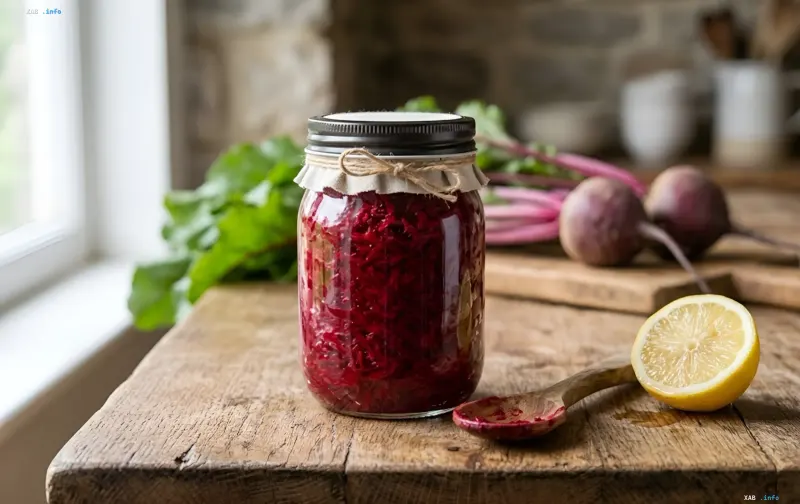
Preserving beets for winter is one of the most practical ways to keep the root vegetable's flavor and color until spring without spending time boiling and chopping it in the middle of winter. According to Styler, the recipe shared by cook Tatyana Shlihtenko on Instagram turns grated beets into a versatile base: it can be added as a ready-made seasoning to borscht, used as a side dish, or served as a standalone salad. The main advantage of the method is replacing aggressive vinegar with citric acid, which gently preserves the vegetable's bright ruby color and makes the preserved product noticeably milder in taste.
Citric Acid Instead of Vinegar: What the Substitution Means
Classic preserving recipes often rely on vinegar, but in this method it is fully replaced by citric acid. According to the recipe's author, this approach not only avoids a sharp vinegar aftertaste but also retains the beets' rich color, which often dulls with vinegar preservation. The result is a milder-tasting preserved product that is easier to fit into a variety of dishes — from soups to cold appetizers.
Step-by-Step Recipe: From Boiling to Canning
The recipe's proportions are calculated for a yield of approximately seven 0.5-liter jars. The beets are thoroughly washed, boiled until tender, and peeled, then grated on a coarse grater. The grated vegetable is transferred to a heavy-bottomed pot, salt, sugar, and vegetable oil are added, and the mixture is stirred well. Over moderate heat, the mass is brought to a boil and simmered for exactly 20 minutes, stirring occasionally. Then citric acid is added, mixed thoroughly, and boiled for another 10 minutes. The hot preserved product is packed tightly into pre-sterilized jars, sealed with lids, turned upside down, and left under a blanket until completely cooled. It is worth noting that the published version of the recipe does not specify exact gram measurements for salt, sugar, oil, and citric acid, so on the first attempt it is best to adjust the amounts to taste and to trusted proportions.
How to Choose Beets So the Preserved Product Turns Out Sweet
The richness of flavor and the stability of color largely depend on choosing the right root vegetable. Preference should be given to medium-sized beets — about 8–10 cm in diameter: overly large ones are often tough, fibrous, take a long time to cook, and are inferior in taste. The sweetest are traditionally round or slightly flattened root vegetables, as well as the elongated 'Zilindra' variety, which is noted for its rich flavor and grates easily. On a cut, the flesh should be a uniform dark burgundy; pronounced white rings inside indicate a forage-type vegetable or an excess of nitrates. The skin should be smooth and firm, free of damage, dark spots, or signs of rot, and the tail of a fresh beet should be thin.
How to Use the Preserved Product in Winter
The finished preserved product is designed for flexible use: it can be added to borscht as an already-cooked seasoning, used as a side dish for meat and vegetable dishes, or served as a standalone salad. This approach saves time in the cold season and allows you to quickly assemble complete meals without lingering on the lengthy stages of preparing beets.