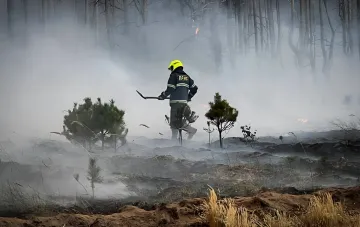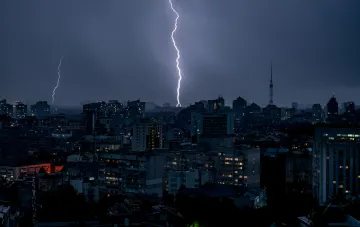

On the night and day of August 22, an active low-pressure area dubbed "Priska" by meteorologists swept across Belarus. According to Belhydromet, the cyclone moved from Polish territory toward the Baltic states, bringing thunderstorms, gusty winds with gusts of up to 97 km/h, and a sharp temperature contrast — from 19°C in the northwest of the country to 36°C in the southeast. By evening, the aftermath of the storm was extensive: emergency repair work was already underway in 659 settlements, and, according to the Ministry of Energy, 1,800 transformer substations, 179 lines of 10 kV, 12 lines of 35 kV, and seven lines of 110 kV had been taken out of service. A further 31 farms and 16 heating plants were also left without power.
Scale and geography of the blackout
The problem grew rapidly. If at 15:00 power supply disruptions were recorded in 148 settlements, then just four hours later that number had risen to 659. The most severe situation developed in Minsk, Vitebsk, and Grodno regions, where strong wind gusts caused trees and branches to fall en masse onto power lines. To eliminate the aftermath, 315 emergency crews and 427 units of equipment were deployed. As of August 23, the center of the cyclone had shifted to the northwest of the European part of Russia, and Belarus found itself in its cold, windy rear sector.
Storm conditions beyond Belarus
The storm conditions associated with "Priska" affected not only Belarusian territory but also neighboring Lithuania, Latvia, and Poland. In Poland, according to available reports, one person died as a result of the bad weather. Thus, the cyclone became a regional weather event that impacted the energy infrastructure of several Eastern European countries at once.
Contradictory data
A number of details remain unconfirmed or incomplete. In particular, the Ministry of Energy did not specify how fully and simultaneously all 659 settlements were de-energized — the figure reflects the total number of locations where work was carried out, but does not necessarily mean a total outage of each of them at a single moment. Moreover, information about a fatality in Poland is presented fragmentarily in the initial reports and requires clarification. Finally, accompanying reports about unmanned aerial vehicles entering Belarusian airspace and about the movement of units toward the Ukrainian border come primarily from media outlets and are not backed by official detailed comments, which makes them part of the context rather than a confirmed fact.
Context: the situation around the country
The weather anomaly coincided in time with other events drawing attention to Belarusian territory. Recently, it became known that a Russian "Bandierol" drone-missile crashed near the town of Kopatkevichi in Gomel region; according to media reports, no fewer than 12 such drones may have entered the country's airspace. A week earlier, there were reports of new units being brought up to the border with Ukraine, although, according to available information, Ukrainian border guards had not yet recorded any signs of preparation for an offensive. The combination of these factors intensifies public interest in what is happening in the country in recent days.