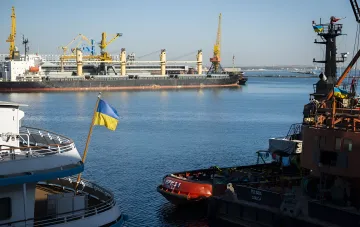
The Russian blockade of the ports of Greater Odesa is dealing a systemic blow to Ukraine's export economy, turning a logistical problem into a production crisis for entire industries. According to estimates by logistics companies, the business community, the National Bank of Ukraine, and industry experts, between $0.8 and $1.2 billion in export revenue is at risk monthly in the base scenario, and up to $1.5–2 billion in the case of large-scale and prolonged restrictions. The NBU forecasts that alone in the second half of 2026 Ukraine may fail to receive around $2.5 billion in export revenue due to problems with maritime shipping, although the regulator expects part of this volume to be compensated in the first half of 2027.
Agro-exports: deferred losses are accumulating in a snowball effect
For the agricultural sector, the consequences of the blockade grow with each passing month. According to calculations by the Ukrainian Conference of Agricultural Exchanges (UKAB), over three months of restrictions Ukraine may fail to ship out around 9 million tonnes of agricultural products worth $1.9–2.8 billion. If the blockade is maintained for six months, the volume of unshipped produce will rise to 16 million tonnes, and the deferred revenue will reach $3.5–5.2 billion. In June, around 90% of Ukraine's grain, oilseeds, and processed product exports passed through the Black Sea ports. After the intensified attacks in July, this share fell to 80%, however overland routes and the Danube remain limited in throughput capacity and are unable to fully compensate for maritime shipping.
Metallurgy on the brink of production collapse
For the metallurgical sector the problem is even more acute, because the plants of the mining and metallurgical complex are oriented toward bulk cargo, for which a rise in logistics costs of tens of dollars per tonne makes export economically unviable. The company Metinvest notes that the mining and beneficiation complex plants are roughly three-quarters oriented toward export. One of the first consequences of the blockade was the suspension of mining at the Southern Mining and Beneficiation Complex (GOK). At the other Kryvyi Rih GOKs of the group, mining in August may fall by around 30% against the 2025 annual average, and rail shipments of products may decrease by around 1.3 million tonnes. In addition, Metinvest's plants need to import around 230–250 thousand tonnes of coking coal monthly, which makes the dependence on maritime imports of raw materials critical. The situation is compounded by the reduction of available quotas for Ukrainian steel in the EU, costs associated with the CBAM mechanism, and more expensive rail logistics. According to available estimates, Russian strikes and the blockade of the ports may cut steel output in Ukraine by 30–40%.
Macroeconomic consequences and pressure on the hryvnia
At the level of the national economy, the blockade means lower foreign-currency earnings, reduced tax revenues, and job losses. A decline in exports against the backdrop of persistently high imports intensifies the devaluation pressure on the hryvnia and increases Ukraine's dependence on external financing. In a broader scenario of a full blockade of Greater Odesa, around 4–5 million tonnes of cargo and $1.5–2 billion in revenue are at risk monthly. This is not only about irrecoverable losses, but also about deferred exports, as well as additional logistics costs that are passed on to the cost of production.
Alternative routes: a partial solution, not a replacement
Experts emphasize that in the short term Ukraine needs to maximize the throughput capacity of alternative routes: expand the fleet of European wagons and locomotives, maintain war-risk insurance, preserve access to the EU market, and reduce logistics costs. However, all these measures can only partially mitigate the crisis. Overland and river directions are not a full alternative to the deep-water ports of Greater Odesa. The key solution for Ukraine's export economy remains the restoration of safe operation of the Black Sea corridor, without which structural losses in the agricultural sector and metallurgy will grow with each passing month.