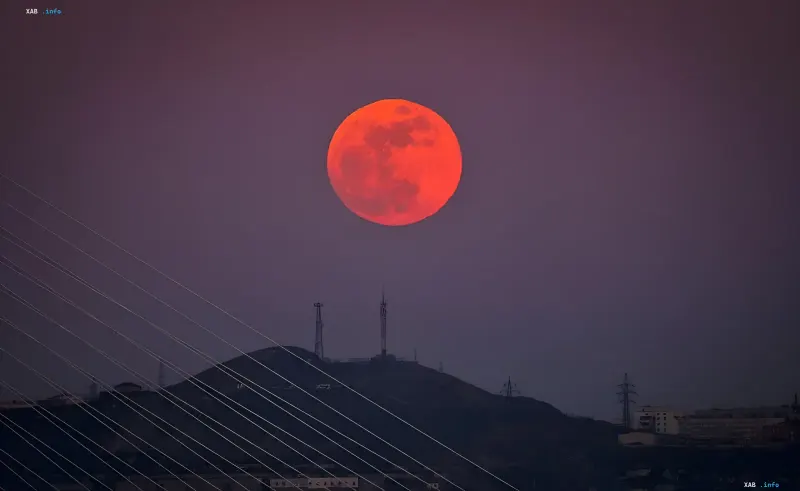
On August 28, 2026, residents of many countries will witness a rare astronomical event — a partial lunar eclipse. As reported by Xbt.com, citing Lyudmila Kosman, head of the methodological support department of the Moscow Planetarium, during this process more than ninety percent of the lunar disk will enter the Earth's shadow. Due to the scattering of sunlight in the Earth's atmosphere, the Moon's surface will acquire a characteristic reddish, so-called "blood" hue, which defines the appearance of the phenomenon.
Timeline and Duration of the Event
According to experts, the total eclipse will begin at 04:24 Moscow time and last until 10:02. Thus, the process covers the early morning hours, which imposes direct limitations on observation conditions: by the time of maximum phase, the sky will already be noticeably lightened by the approaching dawn. It is precisely the combination of the low brightness of the eclipsed disk and the increasing luminosity of the horizon that makes the phenomenon less contrasting than, for example, a full moon in the deep of night.
Where the Eclipse Will Be Visible and Where It Will Not
The phenomenon is in principle available for observation in many regions of the world; however, the geography of visibility is non-uniform. In particular, in Moscow it will not be possible to directly see the eclipse: at the specified moment the Moon will be below the geoid line, that is, below the city horizon. Similar regional restrictions apply to a number of other Russian cities, where the height of the Moon above the horizon at the moment of maximum will be insufficient for visual contact with the disk.
Why Observation Will Be Difficult Even Where the Moon Is Visible
Even in locations where the lunar disk will rise above the horizon, full observation will be complicated by two factors. The first is the relatively low brightness of the eclipsed Moon, which loses contrast against the pre-dawn sky. The second is the gradual lightening of the sky with the onset of dawn, "washing out" the dark silhouette and the reddish color of the disk. Astronomers recommend that observers choose open areas with minimal city light pollution and begin tracking the phenomenon before its maximum phase.
Context and Regional Expectations
Interest in the event is confirmed by publications in a number of regional and foreign media outlets, which in advance analyze whether residents of specific cities will be able to capture the "blood moon." The astronomical phenomenon is regular and predictable in nature: its parameters are calculated in advance, and August 28, 2026 will become another confirmation of the accuracy of such forecasts. For a wide audience, the eclipse remains a vivid demonstration of the mutual arrangement of the Earth, the Moon, and the Sun — one of the most spectacular celestial events of the summer.