Astronomers have reported the discovery of an unusual exoplanet, GJ 523b, which, despite being only 2.5 times larger than Earth, has a mass of about 23.5 Earth masses. Such a high mass combined with a relatively modest radius indicates that the world is composed predominantly of heavy rocky-metallic materials and possesses only a minor gaseous envelope. This contradicts standard ideas about how planets of such mass should form, making the object one of the most mysterious of recent discoveries.
What Is a "Mega-Earth" and What Are the Parameters of GJ 523b
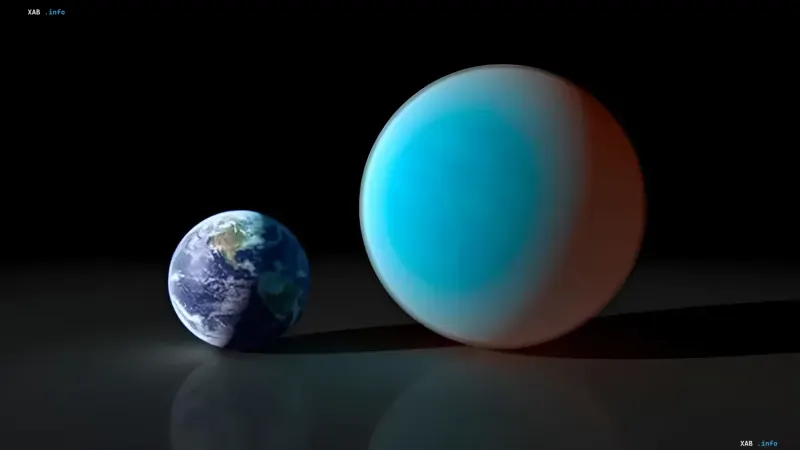
GJ 523b is classified as a so-called "mega-Earth" — an unofficial class of exceptionally massive planets with a predominantly rocky composition. The radius of the discovered world is roughly 2.55 times that of Earth, and its average density is estimated at about 7.74 g/cm³. For comparison: Earth's average density is around 5.51 g/cm³. This difference means that the interior of GJ 523b contains significantly more heavy elements than our world, and that its voluminous hydrogen-helium atmosphere is, most likely, absent or extremely thin.
How the Planet Was Found and Its Mass Measured
The object was initially detected by NASA's TESS space telescope, after which scientists carried out follow-up observations using the 3.5-meter WIYN telescope at the Kitt Peak National Observatory in Arizona. Spectroscopic measurements allowed them to determine how strongly GJ 523b gravitationally "wobbles" its star, and from these data the planet's mass was calculated. The object completes a full orbit around its star in just 17.75 days, and the age of the entire system is estimated at about 170 million years — making it relatively "young" by astronomical standards.
Why the Discovery Challenges Planet Formation Models
It is precisely the combination of youth and enormous mass that makes GJ 523b especially interesting. According to standard models, as a rocky-metallic core grows, it begins to actively attract hydrogen and helium from the protoplanetary disk surrounding the young star. Upon reaching a certain mass threshold, this process can accelerate sharply and lead to the formation of a gas giant — this is how Jupiter and Saturn are believed to have formed in the Solar System. However, GJ 523b has already accumulated a mass of about 23 Earths and yet has not turned into a gas-rich planet. The object's high density directly points to the absence of a significant hydrogen-helium envelope, and astronomers now have to explain how such a massive world retained a predominantly heavy composition.
Possible Explanations for the Anomaly
Among the scenarios under discussion is the loss of an initially existing atmosphere: the planet may have formed with a gaseous envelope but later lost it under the influence of external factors. An alternative scenario suggests that GJ 523b may have arisen from the collision of two large planets, during which their rocky cores merged while a significant portion of their gaseous envelopes was ejected into space. Both options require further verification, and scientists hope to detect more such objects: several dozen ultra-dense "mega-Earths" would help determine whether they are rare anomalies or represent a separate, common scenario of planetary evolution.
Contradictory Data
There are no significant discrepancies in the key parameters between sources, although publications show minor differences in the rounding of figures. Thus, the planet's mass is given as either "about 23 Earths" or "23.5 Earth masses," and its radius as either "2.5 times" or "2.55 times" that of Earth. These inconsistencies stem from different levels of precision and rounding in individual reports, but they do not change the overall picture: this is the same ultra-dense object, whose anomalous mass despite its modest size remains the main subject of scientific interest.
What Comes Next
Astronomers plan to continue the search for similar ultra-dense exoplanets in order to statistically assess how typical the "mega-Earth" scenario is — one that did not turn into a gas giant. Each new such discovery will narrow the range of possible explanations and help refine models of planetary system formation, in which, as it turns out, not everything follows the familiar scenarios of core growth and gas capture.