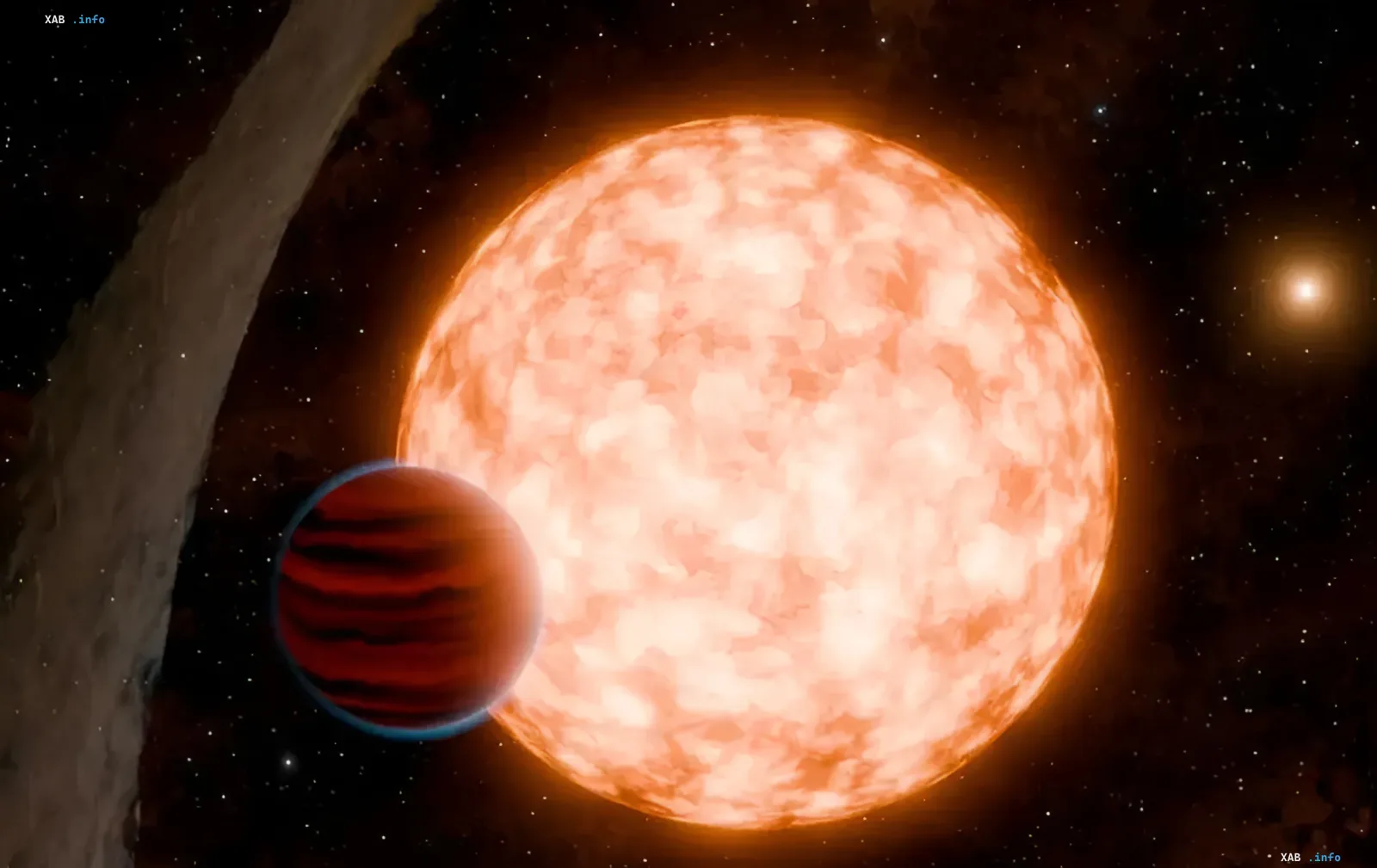
Astronomers have announced the observation of the transit of an exoplanet that, by age, is the youngest ever recorded by this method. The object has been given a dual official designation — IRAS 04125+2902b and TIDYE-1b. For clarity, the researchers offer a scaled analogy: if Earth were 50 years old, the newly discovered planet would be just two weeks old. The planet orbits a protostar in a so-called stellar nursery, where newborn planets are typically hidden by dense clouds of dust and gas for roughly 10 million years and remain invisible to direct observation.
Rare Geometry and the Role of the TESS Telescope
Seeing such a young object was made possible by a rare alignment of several geometric conditions. First, the inner part of the star's dust disk has already emptied, while the outer disk is tilted almost flat relative to Earth, reducing the optical 'veil'. Second, the orbit of TIDYE-1b passes 'edge-on' relative to an observer on Earth, so the planet is clearly projected against the star's disk during the transit. NASA's TESS space telescope detected periodic brightness variations at an interval of about 8.83 days, and to confirm the weak signal against the turbulent data of the young star, the scientists applied a specialized AI algorithm called Notch, which isolated the characteristic transits.
A Puffed-Up Gas Giant on Its Way to Contraction
In size, TIDYE-1b nearly reaches the dimensions of Jupiter: its radius is estimated at about 10.7 Earth radii. At the same time, the object's mass is less than 30 percent of Jupiter's mass, indicating a puffed-up hydrogen atmosphere that has not yet had time to contract and cool. Scientists predict that over the next few hundred million years most of this envelope will disperse, and the planet will shrink to the size of a sub-Neptune or super-Earth, thus passing through the classic stage of early evolution of a gas giant.
The Mystery of the Tilted Orbit
The main unresolved intrigue of the discovery remains the sharp angle of the planet's orbital tilt relative to the plane of the surrounding protoplanetary disk. Among the possible causes, astrophysicists consider the gravitational influence of a neighboring star, internal migration of the planet within the system, or an influx of gas from nearby cosmic clouds. Solving this mystery will help refine models of planet formation and early dynamics in stellar nurseries.
Contradictory Data
In the provided materials, no significant discrepancies between sources on the key figures (radius of about 10.7 Earth radii, mass less than 30% of Jupiter's mass, transit period of 8.83 days) have been recorded. The only point requiring clarification for the reader is the phrase 'two weeks': this is a conditional scaled analogy comparing the relative age of the planet with the age of Earth, not an absolute chronological period in years. The absolute age of the object is not given in the original reports, so it is intentionally not stated in the article in order to avoid inaccuracies.