Astronomers have made a revolutionary breakthrough in space exploration by successfully detecting radio waves emitted directly by an exoplanet for the first time. This historic achievement opens up fundamentally new horizons for science and significantly expands the possibilities in the search for extraterrestrial life. The research was published by an international team of scientists from the Harvard-Smithsonian Center for Astrophysics and the University of Oregon (USA).
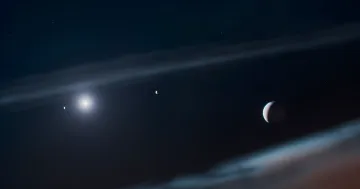
The mysterious signal discovered originated from Beta Pictoris b, a gas giant located approximately 64 light-years away from Earth. The news instantly attracted widespread public attention and sparked numerous discussions about the potential detection of extraterrestrial civilizations.
Nature of the Radio Signal and Natural Origin
In response to public speculation, researchers officially confirmed that the recorded radio waves are entirely natural in origin and do not represent artificial messages. The source of the emission turned out to be powerful natural auroras occurring within the atmosphere of Beta Pictoris b itself.
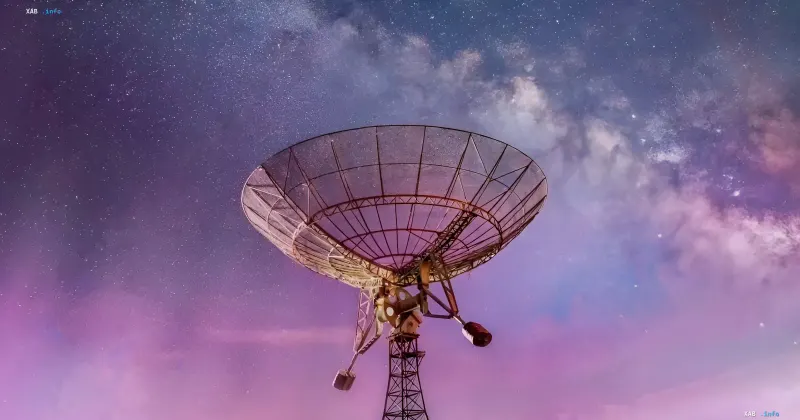
Similarly to the auroras on Earth or Jupiter, this phenomenon is generated when high-energy particles collide with the gaseous envelope and actively interact with the planetary magnetic field. The MeerKAT radio telescope array in South Africa registered distinct series of short, repeating radio bursts with characteristic circular polarization.
Technological Breakthrough in Radio Astronomy
The main technical challenge for researchers over the decades has been separating weak planetary signals from the colossal radio interference of the host star. To overcome this problem, scientists used distant cosmic quaisars as precise coordinate reference points, which reliably proved that the radio waves originated precisely from Beta Pictoris b.
Successful interference filtering made it possible to directly measure the exoplanet's magnetic field strength, which reached an impressive 1,250 Gauss. This value vastly exceeds the figures for Jupiter and Earth, highlighting the unique physical characteristics of the young massive gas giant that completes a full rotation around its axis in just 8-9 hours.
Significance for the Search for Habitable Worlds
Despite the fact that Beta Pictoris b is a gas giant without a solid surface and is uninhabitable for life, the discovery itself is of fundamental importance. Planetary magnetic fields serve as a reliable shield protecting the atmosphere from the destructive effects of stellar wind and radiation.
The refined methods for remotely measuring magnetic fields are planned to be applied in the future to smaller rocky exoplanets. This will enable astronomers to accurately identify worlds capable of retaining liquid water and supporting biological life, opening a new era in space research with the commissioning of next-generation telescopes like the Square Kilometer Array.