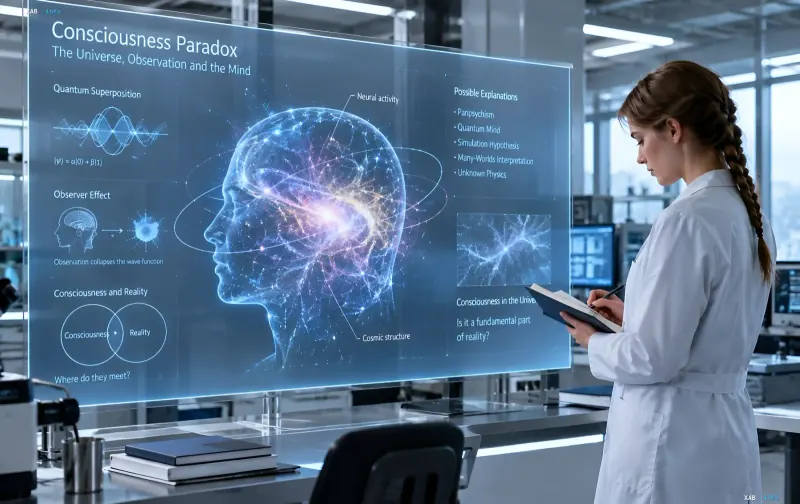
Physicists are examining a hypothesis suggesting that consciousness could randomly emerge from chaos, even in the absence of a universe, stars, and planets. This thought experiment, known as the "Boltzmann Brain," challenges our very understanding of the origins of life and the structure of the universe. This is reported by RBK-Ukraine, citing an article by Dr. Alastair Gunn for the scientific publication BBC Science Focus.
The Problem of Fine-Tuning Constants
As Gunn notes, the fundamental constants of nature can be measured, yet science still does not know why they have these specific values. Even a slight change in these parameters would make the formation of galaxies, stars, planets, and, consequently, life impossible. It is this "fine-tuning" that drives scientists to seek an explanation for the precision of physical constants beyond mere coincidence.
The Multiverse as a Potential Answer
One approach to solving this problem involves assuming the existence of many other universes with different laws of nature, or a single infinite universe where constants vary across different regions of space. In such a scenario, the emergence of life-sustaining conditions appears significantly more probable. However, there is currently no direct evidence for the existence of other universes or an infinite space-time.
What Is a "Boltzmann Brain"?
According to the laws of thermodynamics and quantum physics, random fluctuations are possible in the universe—oscillations that, given enough time, could spontaneously form a conscious object. This is how the hypothetical "Boltzmann Brain" is born: an isolated structure possessing signs of consciousness but unconnected to biological evolution or a planetary environment. Gunn emphasizes that such an observer could have illusory memories and perceive the world just like a normal human being.
The Paradox of Numerical Superiority
The main problem with the hypothesis is that in a sufficiently old universe, random "Boltzmann Brains" should theoretically occur much more frequently than "ordinary" biological observers. If this is the case, it is statistically more likely that any given observer is precisely such a spontaneously emerged brain rather than a product of evolution. This creates a logical paradox that complicates the interpretation of our own observations about the world.
The Uncertain Future of the Universe
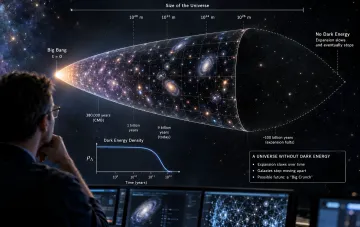
The "Boltzmann Brain" paradox can be avoided if the universe is not eternal—in this case, the window for accumulating fluctuations is limited, and the number of spontaneously emerging conscious objects remains smaller than the number of biological observers. However, scientists have not yet reached a consensus regarding the ultimate future of the universe: whether it will expand forever, collapse, or stop at a state of equilibrium. As long as this question remains open, the scientific picture allows for the probability of our existence, but not its absolute certainty.