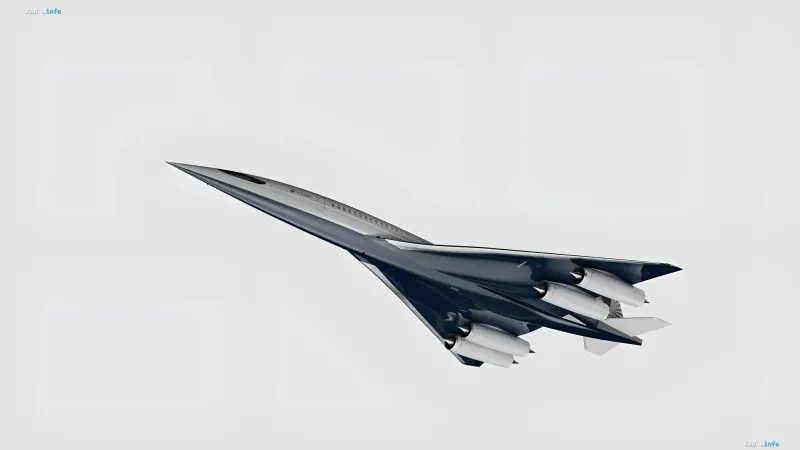
On November 21, 2026, Boom Supersonic conducted the first test run of a prototype gas generator for its proprietary aircraft engine at a test site at the Colorado Air and Space Port near Denver. These tests mark a key milestone in the development of the Symphony power plant, which is designed to propel the Overture supersonic passenger airliner to a cruise speed of Mach 1.7—roughly 2,100 km/h. According to founder and CEO Blake Scholl, the first run succeeded on the second attempt, with engineers initially estimating the probability of a successful start at less than 50%. The initial run was intentionally kept short to verify the operation of core systems and gather maximum diagnostic data. Over the next two months, the company intends to gradually expand the test program.
One Gas Generator, Two Power Plants
The gas generator tested is the core that will form the foundation for two fundamentally different power plants. The first is the Superpower industrial gas turbine, rated at 42 MW, designed to provide energy for data centers, including those powering artificial intelligence systems. The second is the Symphony turbofan engine with approximately 40,000 pounds-force (approx. 178 kN) of thrust, which is planned for the Overture supersonic airliner. Both units will utilize a shared gas generator featuring a six-stage high-pressure compressor and a single-stage high-pressure turbine. The designs will differ in the low-pressure section: the industrial Superpower version will have a four-stage compressor, while the aviation-grade Symphony will utilize a three-stage compressor. The Symphony engine will also be significantly lighter as it does not require the same configuration as a stationary unit. Boom expects to begin testing a fully assembled engine around the middle of 2027.
In-House Casting: Controlling Critical Components
Parallel to the gas generator testing, the company is establishing an in-house casting facility for producing single-crystal blades and turbine nozzles from specialized heat-resistant alloys. The facility will be located at the new ~18,600 m² Superpower Superfactory production complex in Colorado. The production process will be fully digital and will not require traditional tooling. Boom explains this as a strategy to maintain internal control over critical components that are difficult and time-consuming to procure from third-party suppliers. This approach reduces the supply chain and accelerates development iterations.
Context: The Supersonic Race Heats Up
Boom Supersonic’s testing occurs amidst a broader revival of interest in supersonic passenger travel. While the segment remained virtually dormant in the 2020s following the retirement of Concorde and the X-59 programs, several players have entered the market by 2026. In the same month of November 2026, reports surfaced that China is preparing a demonstration unit, the TMS-10, for final assembly—a 10–15 passenger supersonic business jet optimized for Mach 2 cruise speeds, with a maiden supersonic flight planned before the end of the current year. Thus, Boom Supersonic and Chinese research groups are operating within the same timeline, making each successful test phase a notable event for the entire industry.
What’s Next: The Roadmap to Flight
For Boom Supersonic, the successful gas generator run is not the finish line, but the start of a long fine-tuning phase. Expanding the test program over the coming two months will allow for the collection of statistics on service life, thermal regimes, and component stability. The next major milestone will be testing the fully assembled Symphony engine in mid-2027, followed by the integration of the power plant into the Overture airframe. The company emphasizes that the goal is not merely to prove engine viability on a test stand, but to create a production-ready power plant capable of supporting commercially viable supersonic flights. Successful completion of each of these stages will determine how realistic Boom’s plans for launching supersonic passenger travel by the end of the decade truly are.