In the context of modern warfare, where the cost of an air defense interceptor is tens of times higher than that of an attack drone, the tactic of 'asymmetric attrition' becomes a key factor in victory. The British company OM Defence Systems has presented a solution capable of radically changing the balance of power in the air: the Spectr drone. This device, which is already undergoing field trials in Ukraine, does not carry a warhead in the traditional sense. Its main task is to become a 'ghost' that forces enemy radars to see a target 20 times larger than it actually is.
The Physics of Deception: How the Retroreflector Works
The secret of Spectr's effectiveness lies not in its aerodynamics or speed, but in its unique on-board electronics. According to technical data, the drone is equipped with a microwave retroreflector weighing only 1.2 kg. This device operates in a wide frequency range from 3 to 20 GHz, covering most modern radar systems. The principle of operation is simple and ingenious: it receives incoming radar signals from the enemy radar and immediately returns them with amplified power.
The result of this operation is an artificial increase in the drone's radar cross-section (RCS) by 20 times. For the air defense operator, Spectr appears on the radar screen not as a light reconnaissance vehicle, but as a large military aircraft or helicopter. This forces the adversary to make a decision to intercept, expending expensive surface-to-air missiles to destroy a relatively cheap 'gadget'.
Hunting Tactics: The Spectr and Kestrel Duo
OM Defence Systems developers do not view Spectr as a standalone weapon. Its effectiveness is revealed in conjunction with another British drone — the Kestrel interceptor. The scheme of operation for this pair resembles wolf hunting: Spectr acts as 'bait', luring enemy air defense systems out of hiding. As soon as the enemy radar begins active tracking of the 'enlarged' target, it reveals its exact location.
At this moment, Kestrel comes into play, intercepting the coordinates and destroying the radar or launch site. Thus, Spectr performs a dual function: it not only depletes the enemy's ammunition but also turns their own detection means into a source of intelligence for allies. This allows for precision strikes against air defense positions, making the sky safe for other strike groups.
Technical Specifications and Combat Readiness
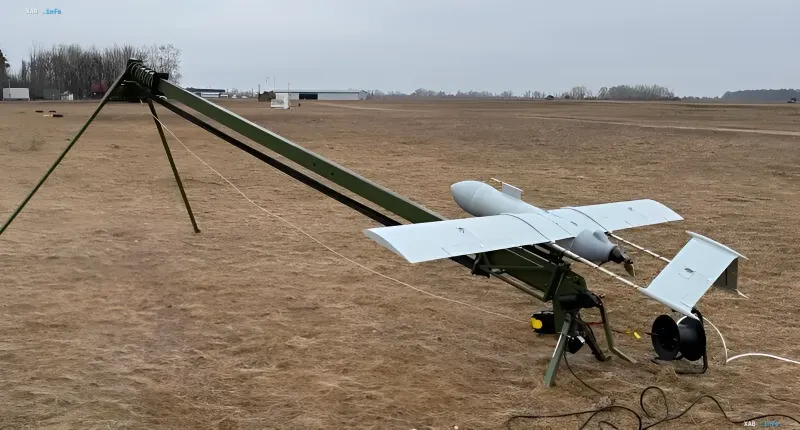
The Spectr design is optimized for rapid deployment in field conditions. The drone's fuselage is made of polyvinyl chloride (PVC), making it lightweight and cheap to manufacture. To launch the device, a long runway is not required; it uses a catapult launch, allowing it to be taken into the air from the most unexpected places, including forests or suburban areas.
At the moment, the project has reached the 6th level of technology readiness (TRL 6). This means that the prototype has already passed successful tests in conditions as close to real combat as possible. The drone is equipped with an electric motor, propeller system, and GPS navigation, ensuring its autonomy and flight accuracy. Currently, the system is being actively tested by the Ukrainian military, who are evaluating its effectiveness in real combat conditions.
Contradictory Data
Although the technical specifications of Spectr look impressive, there are different opinions in the expert community regarding its tactical role. On the one hand, British developers position it as part of a comprehensive Suppression of Enemy Air Defenses (SEAD) system, working in conjunction with Kestrel. On the other hand, some analysts note that in conditions of dense electronic warfare (EW), the effectiveness of the retroreflector may be reduced. If the enemy uses active jamming, the drone may not only fail to 'enlarge' on the radar but also become an easy target for EW means that can easily calculate the source of the reflected signal.
The Future of Asymmetric Wars
The appearance of Spectr marks a paradigm shift in the development of unmanned technologies. If previously the emphasis was on creating 'killers' with powerful warheads, now 'hunters' and 'deceivers' come to the fore. The ability of a cheap drone to force the enemy to spend millions of dollars on its destruction makes it one of the most effective tools of modern warfare. In the future, we may see the mass use of such decoys, which will work in swarms, creating a 'storm' of false targets on enemy radar screens, completely paralyzing the enemy's air defense system.