August 19, 2026.
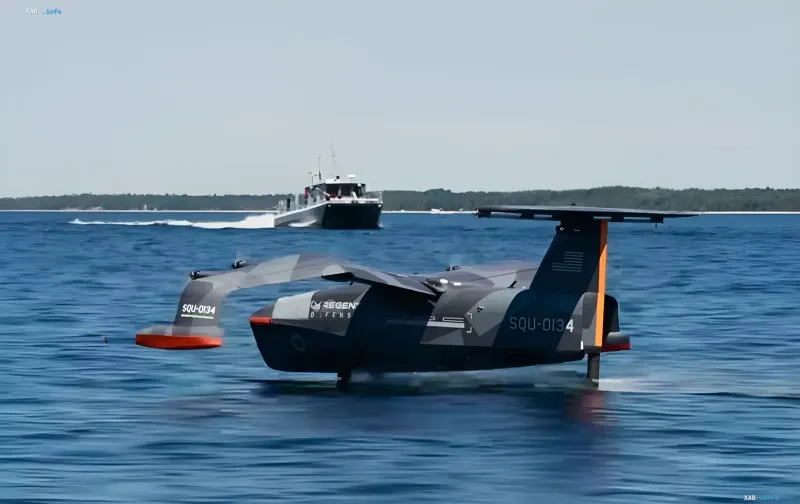
At the end of July 2026, large-scale military exercises known as Silent Swarm concluded in the state of Michigan, during which a new American unmanned system was successfully tested. The autonomous amphibious drone Squire, developed by Regent Craft, demonstrated its capabilities during the 13-day maneuvers held from July 13 to 24. The exercises, which covered the Northern Lower Peninsula of Michigan and the Alpena Combat Readiness Training Center, served as a proving ground for practicing complex electronic warfare scenarios.
Wing-in-Ground Technology and Stealth
A key feature of the Squire platform is its classification as a Seaglider USA-V — a wing-in-ground effect vehicle capable of flying within a wingspan distance above the water surface. This aerodynamic configuration allows the vehicle to remain below the horizon for line-of-sight radars, which is critical for modern combat conditions. According to the manufacturer, the platform can reach speeds of up to 70 knots, and its planned range exceeds 100 nautical miles (185 kilometers). This makes Squire an ideal candidate for reconnaissance, surveillance, and precision logistics tasks in coastal zones.
Focus on the Electromagnetic Spectrum
The primary objective of the Silent Swarm exercises was to practice operations within the electromagnetic spectrum. The military tested how small multi-domain unmanned systems could utilize radar, communications, navigation, infrared, and directed energy signals, as well as defend against them. The Squire drone operated with various payloads throughout the 13 days, testing roles in electronic attack, electronic protection, and electronic support. This marked a significant step in integrating civilian technologies into military communication and defense protocols.
Joint Interoperability and Feedback
The uniqueness of the tests lay in the fact that the drone operated in coordination with various branches of the military. Regent Craft noted that they received feedback from military and civilian specialists from the Air Force, Army, Coast Guard, Marine Corps, and the U.S. Navy. Earlier this year, the company had already conducted live missions for rescue and logistics with the Marine Corps Warfighting Lab, including beach evacuations and open-sea rescues. The successful completion of the Silent Swarm exercises confirms the platform's readiness for medical evacuation and anti-ship warfare missions.
Prospects and Contracts
Regent Craft already holds a $15 million contract with the U.S. Marine Corps, as well as formal cooperation agreements with the U.S. Special Operations Command and the Coast Guard Research Center. Despite signed defense agreements with partners on four continents, the company has not yet disclosed exact timelines for when Squire will enter full operational service. Nevertheless, the vehicle's first flight in April 2026 marked the first testing of a military-grade wing-in-ground effect vehicle in the U.S., opening a new era in the development of maritime unmanned systems.