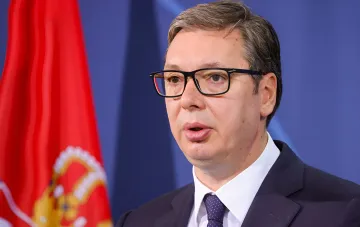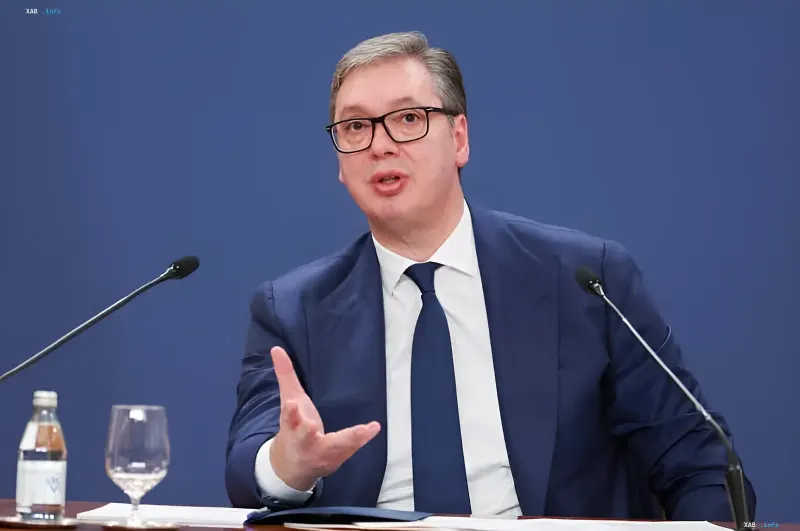
The President of the National Assembly of Serbia and one of the key figures of the ruling Serbian Progressive Party (SNS), Ana Brnabić, publicly outlined on 22 August 2026 a plan to keep Aleksandar Vučić at the helm of the state after his second presidential term expires. During a campaign tour of SNS party stands in Belgrade's Resnik district, as well as at the Cveto market and in Borča, the parliament speaker stated the intention to amend the country's fundamental law to circumvent the constitutional ban on a third term. "We will all be voting, right? So after that, while Vučić is prime minister, we will change the constitution, and then he will be able to become president again. That's it, we have a solution for everything," Brnabić said, addressing party activists and journalists.
The ruling party's "rook move" formula
Brnabić's statement effectively reveals a multi-stage scheme that Serbian political circles are already calling the "Serbian rook move." The first step involves Vučić leaving the presidency ahead of schedule and leading the Serbian Progressive Party in the upcoming parliamentary elections, running as a candidate for prime minister. The second step is Vučić's move into the cabinet of ministers, which would allow him to retain de facto control over administrative and security resources during the constitutional reform. The third and final stage is the abolition of the two-term presidential limit or the resetting of previous mandates through amendments to the Constitution, after which Vučić could run for the highest state office again "from a clean slate."
Constitutional limits and legal context
Under the current Article 116 of the 2006 Constitution of Serbia, one person may not hold the office of president of the republic more than twice. Aleksandar Vučić's second five-year term expires in 2027, which legally closes the possibility of his re-nomination without adjusting the fundamental law. At the same time, any changes to provisions on the organization of state power, including articles on presidential terms, require not only a qualified two-thirds majority in the National Assembly but also the mandatory submission of the amendments to a nationwide referendum in accordance with Article 203 of the Constitution. This creates a significant procedural barrier, especially amid political turbulence.
Early elections and the legitimacy crisis
Brnabić's remarks came against the backdrop of Vučić himself announcing early parliamentary elections, scheduled for 18 or 25 October 2026. Serbia has already been in a state of deep political turbulence for more than a year and a half: since the end of 2024, the country has been rocked by large-scale anti-government protests by student movements and the opposition, fueled by corruption scandals and the tragedy at the railway station in Novi Sad. The protest movement views Brnabić's proposal as an open attempt to usurp power and to copy the model of constitutional "resetting" previously used in a number of authoritarian regimes. Opposition parties have already stated that they will not allow the fundamental law to be rewritten for one person and intend to challenge any amendments in international institutions.
Contradictory data
Within the ruling coalition itself, there is a noticeable divergence in public rhetoric. While parliament speaker Ana Brnabić openly and unambiguously advocates changing the Constitution to keep Vučić in power, the president himself has repeatedly stated in previous public appearances that he does not plan to change the fundamental law to suit himself and has emphasized his commitment to the existing constitutional norms. This creates a contradiction in the positions of the two key figures of the SNS: on the one hand, the formal head of state publicly distances himself from the idea of a "reset," while on the other, the parliament speaker, acting on behalf of the ruling party, openly announces a constitutional reform as part of the election strategy. Observers note that such discrepancies may be either an element of intra-party maneuvering and role distribution, or a reflection of a real disagreement within the SNS elite over the acceptable limits of power concentration.
International reaction and risks to Eurointegration
An attempt to constitutionally enshrine the non-removability of power in Serbia will inevitably intensify the already tense process of the country's Eurointegration. Brussels and the Venice Commission of the Council of Europe, which have already expressed concern about the state of the rule of law in Belgrade, are highly likely to classify such amendments as a regression in democratic standards. For Serbia, which is striving to obtain candidate status for EU membership, this threatens to freeze the negotiation track and increase pressure on the ruling coalition. In a climate of a divided society and ongoing street protests, implementing the "rook move" scheme carries the risk of escalating political tension into a phase of direct civil confrontation, which could have unpredictable consequences for regional stability in the Balkans.