
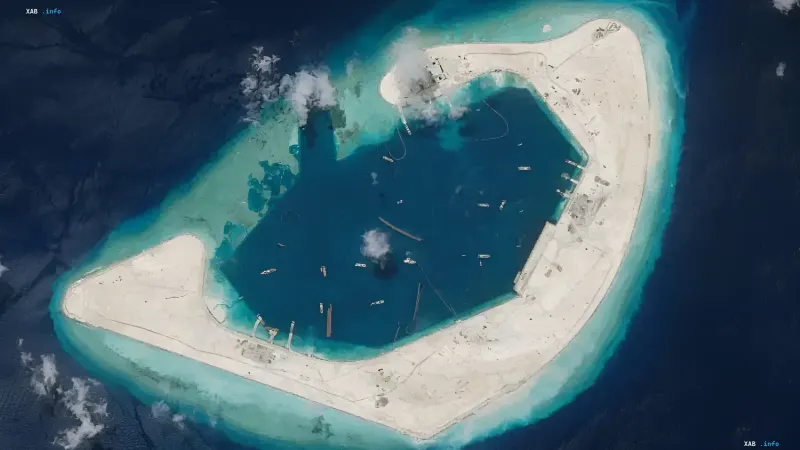
China has completed the first phase of construction of a large artificial island on Antelope Reef in the Paracel Islands of the South China Sea. This is reported by Reuters, citing satellite images studied by the outlet. After nearly six months of continuous construction work, vessels and dredgers — specialized technical equipment for excavating and clearing seabed sediment, sand, and gravel — have left the site. According to available data, the length of the new artificial island is about six kilometers, and on its straight stretch of coastline measuring more than three kilometers, a runway for aircraft could likely be built.
What the satellite images show
In the images taken by Vanthor on July 19, it can be seen that construction of a helipad and a number of other structures has already begun in the southeastern part of the island. In addition, a deep-water port 680 meters long is already operational in this area, which, according to experts, is capable of accommodating large vessels. The presence of numerous vessels and infrastructure elements in the reef's waters is captured in the images, indicating the completion of the main reclamation phase and the transition to the construction of onshore facilities.
Civilian or military purposes
China's Ministry of Defense has not yet officially commented on these construction works. According to information disseminated by Chinese state media, the facility is intended for weather observation and forecasting, scientific research, and meeting other civilian needs. Chinese scholar Ding Duo also emphasizes in his statements that the works on Antelope Reef are being carried out exclusively for peaceful and civilian purposes. However, international experts hold a different view, believing that the new facility could become one of the PRC's largest military bases in the region.
Strategic significance of Antelope Reef
Experts emphasize the high strategic significance of Antelope Reef. In particular, in the event of a conflict related to Taiwan, this area could become an important strategic point for China. According to expert Ben Lewis, Antelope Reef is larger than the nearby Woody Island and occupies a more advantageous position in terms of defense. In the words of Australian professor Carl Thayer, these facilities in peacetime will simplify monitoring of the actions of the United States and its allies, while in the event of a possible armed conflict, the new infrastructure could create additional strategic complications in the region. The island, according to analysts, will give the PRC a significant advantage in monitoring submarine movements and military activity in the surrounding waters.
Contradictory data
There is a significant discrepancy between the official statements of Beijing and the assessments of independent experts in interpreting the purpose of the facility. The Chinese side insists on the civilian profile of the construction — meteorological observation, scientific research, and servicing fishermen. At the same time, satellite data record infrastructure characteristic of military bases: a potential runway more than three kilometers long, a helipad, and a deep-water port capable of accommodating large vessels. International analysts point out that such a configuration of facilities does not correspond to exclusively civilian tasks and indicates the military potential of the reef. The PRC's Ministry of Defense has not provided an official comment to date, leaving the question of the island's actual purpose open.
Vietnam's reaction and the international context
Vietnam claims its sovereignty over the Paracel Islands and strongly opposes the construction work being carried out by China in this area. The dispute over the Paracel Islands remains one of the most acute in the South China Sea, where territorial claims intersect with the interests of several states. Experts note that the new island could allow the PRC not only to expand its military infrastructure but also to significantly strengthen control over maritime activity in this area, which inevitably heightens tensions in the region.