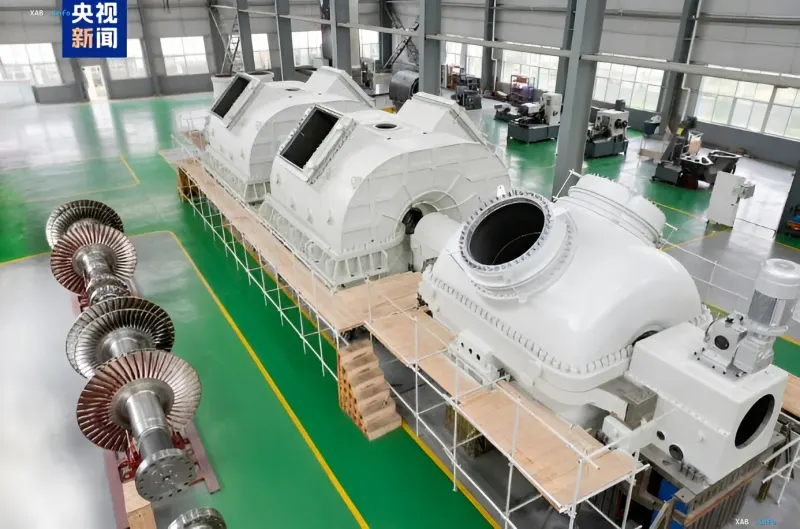
In a production facility in China, a unit has rolled off the assembly line that developers are calling the world's first 600 MW expander for a Compressed Air Energy Storage (CAES) system. The equipment was created by the Institute of Engineering Thermophysics of the Chinese Academy of Sciences in collaboration with China Storage & Energy and, according to the developers, is based entirely on Chinese technology and protected by independent patents. Photos from the production line show a large white turbo-generator housing installed on a temporary support with scaffolding, and alongside it, a series of multi-stage turbine shafts, consistent with the description of the unit's key components.
What the expander does and why it is critical for the system
The expander is one of the central elements of a CAES system: it is what converts the energy of compressed air, stored in a reservoir, into electrical energy. According to the developers, engineers spent nearly two years working on improving the unit's efficiency and solving challenges related to variable rotation speeds, a wide range of loads, and equipment control. As a result, a design with a multi-stage shaft, complex aerodynamics, and a geometry and rotation speed regulation system was created.
Tests and claimed characteristics
The unit has already undergone integration and mechanical testing. According to the developers, all results meet or exceed design requirements. Claimed advantages include high efficiency, a compact design, fast startup and shutdown, a long service life, and ease of maintenance. It is emphasized that the equipment is fully localized in China.
The economics of transitioning from 300 MW to 600 MW
The transition from 300 MW systems to 600 MW units, according to the developers, will allow for doubling the scale of such systems. At the same time, the cost per unit of installed capacity is said to decrease by 20–30%, and the efficiency of the entire system will increase by 3–5%. The creators believe that the new unit will be an important step in the development of compressed air energy storage technologies and their scaling for grid-level tasks.
Thus, the announced unit is positioned as a technological and manufacturing milestone: not just an increase in power, but a change in the installation architecture that allows for a simultaneous reduction in unit cost and an increase in efficiency. Further verification of these metrics will depend on the results of operation in real power grids.