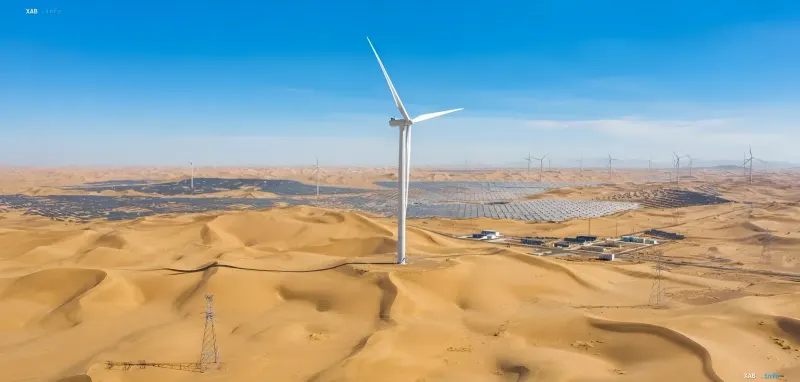
In Inner Mongolia (China), the first wind turbines of a 300 MW wind farm built directly in the center of the Ulan Buh Desert have been connected to the power grid. According to operators, this is the country's first project of its kind implemented deep within a desert area rather than on its periphery. At the first stage, 16 of the 30 installed turbines with a total capacity of 160 MW were connected to the grid; the remaining 14 units will be commissioned as soon as commissioning work is completed. Upon reaching full capacity, the facility will become part of the region's large renewable energy complex.
Technical Configuration: 30 Turbines, 39 km of Lines, and Two Substations
The wind farm includes 30 wind turbines with a capacity of 10 MW each, 39 kilometers of overhead power transmission lines, and two 220 kV substations. This configuration allows generated electricity to be transmitted over significant distances with minimal losses. Connecting the first 16 units confirms that the infrastructure — from foundations to substations — is ready to operate in conditions previously considered unsuitable for large-scale wind energy.Construction Amid Shifting Dunes
Construction was accompanied by a number of challenges untypical for wind energy. Roads used to transport bulky equipment were constantly covered by shifting sands, and loose soil did not provide sufficient stability for the foundations of turbines weighing hundreds of tons. The terrain beneath the builders' feet changed from season to season, making standard installation techniques impossible. Contractors were forced to develop specialized solutions: technologies for strengthening foundations in loose sandy soil, systems to protect power lines from sand drifts, and schemes for transporting heavy equipment across shifting dunes.
Experience for Future Desert Mega-Projects
According to the developers, the experience gained during the construction of the Ulan Buh wind farm will be systematized and applied in the construction of other large wind and solar energy complexes in China's desert regions. This is especially relevant given that a significant portion of the country's unused desert land is concentrated precisely in the northern and western provinces, where traditional infrastructure is absent.
Part of the 2 GW 'Anhai — Ulanqab' Complex
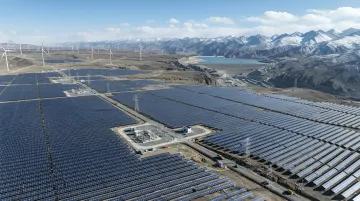
The 300 MW wind farm is an element of the larger 'Anhai — Ulanqab' project, with a total capacity of 2 GW. In addition to wind turbines, the complex includes solar power plants with a total capacity of 1.7 GW and a 300 MW energy storage system. Upon completion, the entire complex will be able to transmit about 4.18 billion kWh of electricity to the Ulanqab region annually. The wind farm itself will generate approximately 690 million kWh per year.
Environmental Impact and Combating Desertification
According to the developers' calculations, the operation of the wind farm will save approximately 227,000 tons of standard coal annually and reduce carbon dioxide emissions by 590,000 tons. The project is also positioned as a tool combining renewable energy development with the fight against desertification: the wind farm infrastructure, including soil stabilization and protection against sandstorms, is expected to help stabilize dunes in the installation area.