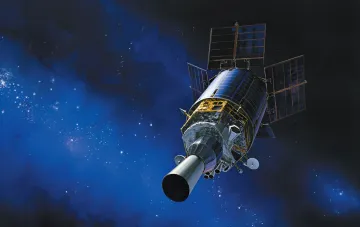
Chinese scientists have successfully completed a series of orbital tests of bidirectional laser communication between Earth and the Moon, demonstrating a stable data transmission rate of up to 100 Mbit/s over a distance of more than 400,000 km. This is reported by the Xinhua news agency, as cited by RBC-Ukraine. According to the researchers' estimates, the created "information highway" will become key infrastructure for future crewed lunar missions and the construction of an international scientific station, enabling the rapid transmission of large volumes of scientific data, high-resolution images, and video materials in real time.
Three Engineering Challenges That Had to Be Solved
In developing the system for operation at lunar distances, Chinese specialists managed to overcome three fundamental technical problems. The first is beam pointing accuracy: due to the satellite's oscillatory movements and atmospheric turbulence, even the slightest deviation of the beam angle on Earth causes the spot on the Moon's surface to shift by several kilometers. The second is signal attenuation: after traveling 400,000 km, the laser beam weakens to the level of individual photons, which arrive at the receiving telescope against a background of interference from sunlight, moonlight, and city lights. The third is throughput: the need to ensure a high rate of data processing under conditions of extreme channel noise.
How Chinese Engineers Outsmarted Physics
To compensate for beam deviations, the researchers developed a tracking system that accounts for orbital delays, as well as optical and atmospheric refraction. This made it possible to keep the narrow laser beam locked onto the receiving antenna on the Moon despite the continuous movement of both communication points. To extract the weak signal from background noise, high-speed superconducting single-photon detectors were used — devices capable of registering individual quanta of light and thereby restoring the information flow that would simply be lost in interference in traditional microwave radio channels.
Test Results and Application Prospects
During the series of tests, the specialists achieved a stable bidirectional data transmission rate of up to 100 Mbit/s. Compared with traditional microwave radio channels, laser communication provides a significantly higher density of the transmitted stream per unit of radiated power, which is critically important given the limited energy resources of orbital and lunar vehicles. Chinese scientists emphasize that the infrastructure created will be used in organizing crewed lunar expeditions and in the construction of an international scientific station, where the volumes of telemetry and multimedia data will many times exceed the capabilities of existing radio channels.
Context: China's Place in the Lunar Technology Race
The achievement of the Chinese side fits into the overall trajectory of the national space program, which includes automated and planned crewed lunar missions, as well as the creation of orbital infrastructure. Laser communication at interplanetary and cislunar distances has long been considered one of the priority directions in the space industry: NASA and ESA are also conducting development in this area, however, the public confirmation of stable bidirectional transmission at the level of 100 Mbit/s over a distance of more than 400,000 km makes China the first country to demonstrate such a result under conditions of real orbital testing.