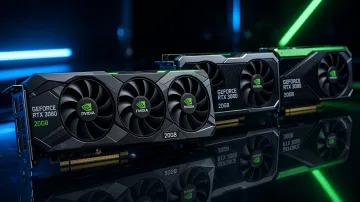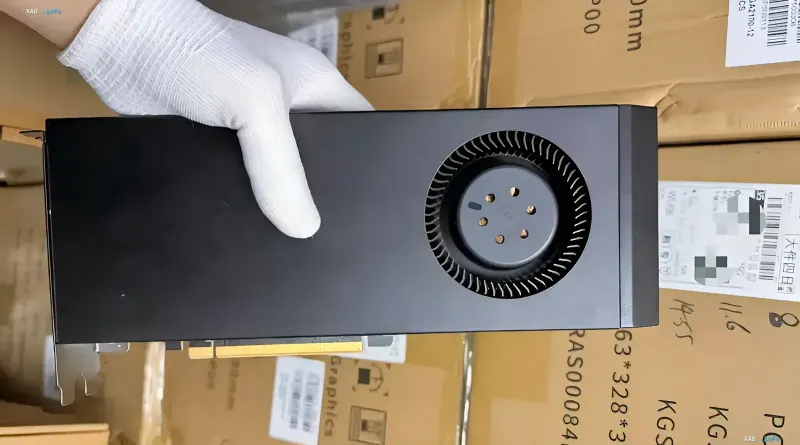
In August 2026, the Chinese computer hardware market is experiencing a new wave of development in its unofficial segment. The portal VideoCardz has recorded a mass appearance on the secondary market of GeForce RTX 40 series video cards that have undergone deep modification. We are talking about RTX 4080 models where the video memory volume has been increased from the original 16 to 32 GB. The cost of such "upgraded" units ranges around 10,000 yuan (approximately $1480), making them an attractive but risky proposition for enthusiasts and artificial intelligence specialists.
Technical essence of the modification: bypassing hardware limitations
The official specification of the GeForce RTX 4080 implies the use of 16 GB of GDDR6X memory with a 256-bit bus. However, Chinese modifiers have found a way to bypass this limitation. The process involves physically replacing lower-capacity memory chips with higher-capacity modules. The key stage is flashing the BIOS and changing configuration parameters so that the graphics processing unit (GPU) recognizes the increased memory volume.
It is important to understand that doubling the memory volume does not change the bus architecture. The bit width remains at 256 bits, meaning there is no increase in bandwidth. Nevertheless, for tasks sensitive specifically to memory volume (such as rendering complex scenes or training neural networks), such a card becomes functionally more powerful than the original.
Market evolution: from isolated cases to a conveyor belt
The phenomenon of modifying NVIDIA video cards in China is not new. Previously, the market saw RTX 4090 and 4090D models with memory increased to 48 GB. Last year, there was also a surge in offers for RTX 4080 Super with 32 GB of memory, offered for 9,200 yuan. A distinctive feature of those models was often specific cooling systems with radial fans.
However, the current situation, recorded in August 2026, indicates a paradigm shift. The market has been flooded not only with "Super" versions but also with standard RTX 4080s. This indicates that modifications have ceased to be the domain of individual repair shops or one-off projects. A full-fledged segment of the Chinese used video card market is forming, where modified devices are produced and resold on an industrial scale.
Economic feasibility and target audience
Who are these cards created for? The main driver of demand is the shortage of affordable solutions with large memory volumes. For buyers interested in having 32 GB of video memory, the modified RTX 4080 represents a more advantageous alternative to the flagship RTX 4090 (which has only 24 GB) or professional A-series cards, the cost of which is significantly higher. Such video cards are most often used for tasks related to AI, where memory volume is a critical factor.
Contradictory data and operational risks
Despite the attractive price, purchasing such devices is associated with serious risks, which can be divided into software and hardware. First, these video cards are not officially supported by NVIDIA or partner manufacturers. The original warranty is voided immediately after opening the case and replacing the chips.
The most acute issue remains software compatibility. Modified cards often require the use of specific drivers. Users report that with every update of standard NVIDIA drivers, the card may stop working, requiring the manual installation of modified versions. This creates constant inconvenience for gamers.
Secondly, the durability of such cards remains in question. It depends directly on the quality of the printed circuit board, the accuracy of the soldering process, and the qualification of the master performing the modification. Unlike factory solutions, there are no guarantees of component and assembly quality here, making the purchase a lottery.