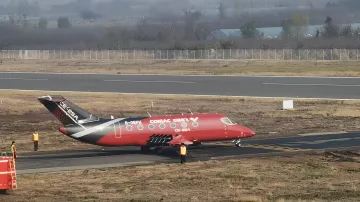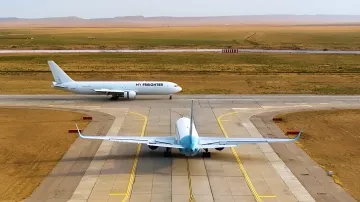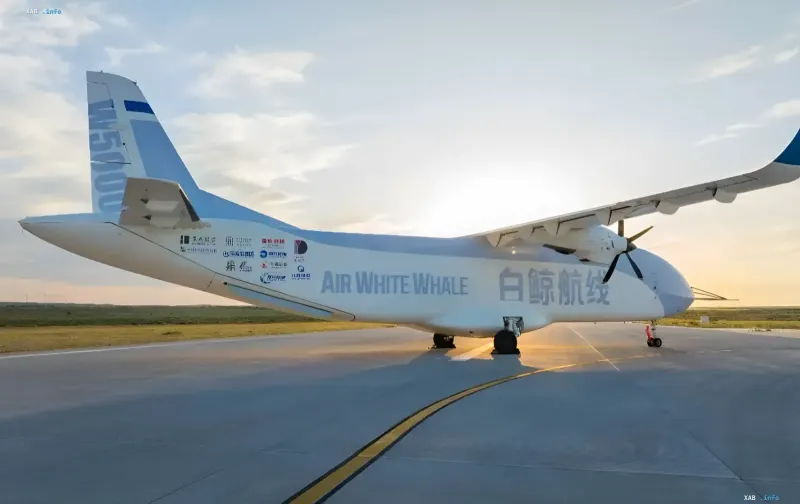
On November 14, 2026, at the Otog-Tianke General Aviation Airfield in Inner Mongolia, the W5000 unmanned cargo aircraft successfully completed a technical test flight. The vehicle was designed and manufactured by the Chinese company Air White Whale (Baijing Hangxian, 白鲸航线), with its name and W5000 markings displayed on the fuselage and tail. The flight marked a stage in the technical verification of the aircraft, which the developers position as a large drone for regional logistics.
Test Flight Progress
For takeoff, the aircraft was configured with flaps deflected at 8 degrees and landing gear extended, with engines operating at full thrust. After a takeoff roll of about 600 meters, the W5000 lifted off, then climbed at an indicated airspeed of about 220 km/h and a vertical speed of approximately 5 m/s, reaching 1,000 meters above the airfield. The flight lasted about 30 minutes, during which the vehicle performed a climb, horizontal flight, turns, descent, and approach, following a route with four turns at a bank angle of about 20 degrees and a speed of 220 km/h. Before landing, the aircraft descended to 500 meters above the airfield and performed a landing approach at an angle of about 3 degrees. The test verified flight control stability as well as the coordinated performance of the power plant, flight control system, avionics, and ground monitoring and control equipment.
Specifications and Purpose
According to the developers, the W5000 has a payload capacity of 5 tons, a cargo hold volume of over 65 cubic meters, and a maximum range of up to 2,600 km. The aircraft is compatible with a range of standard aviation containers and pallets and is designed for interregional cargo transport, cold chain logistics, and emergency delivery. The unit operates in an "autonomous control + ground monitoring" mode and can be operated at civil and general aviation airfields, which lowers infrastructure requirements compared to traditional cargo airliners.
Economic Impact and Localization
Founder, Chairman of the Board, and CEO of the company, Hu Zhengdong, stated that the ton-kilometer cost of the W5000 is at least 60% lower than that of traditional crewed cargo aircraft of this class. According to him, the savings come from the absence of flight crew costs and passenger cabin equipment, which reduces the aircraft's weight and fuel consumption. Hu Zhengdong also noted that the aircraft is equipped with a Chinese turboprop engine, and the airframe design extensively utilizes domestic carbon composites, reducing dead weight and increasing the proportion of cargo in the takeoff weight. He asserted that the company maintains full control over the design, flight control system, avionics, power plant, and composite airframe within China.
Production and Outlook
Air White Whale opened its production base in Changzhou in May 2023, and the first W5000 "Longcheng-1" aircraft rolled off the assembly line on October 18, 2024. Currently, the company holds preliminary orders for 835 aircraft. Commercial operation of the W5000 is planned to begin at the end of 2027; work on model refinement and flight certification is ongoing.
Context: Unmanned Logistics in Medicine
The W5000 tests occur against a backdrop of expanding drone usage in cargo and medical logistics. In October, the Ukrainian government launched an experimental project for delivering medical cargo via drones: the first participant was the Heart Institute of the Ministry of Health, which operates three specialized drones capable of covering up to 700 km and carrying medicines, blood samples, and donor organs. In the same month, the Defense Forces conducted the world's first medical evacuation using a heavy drone, rescuing a 30th Mechanized Brigade infantryman from a position blocked by the enemy. These examples underscore the growing interest in unmanned platforms as a tool for delivering critical supplies in conditions where traditional aviation is either inefficient or inaccessible.