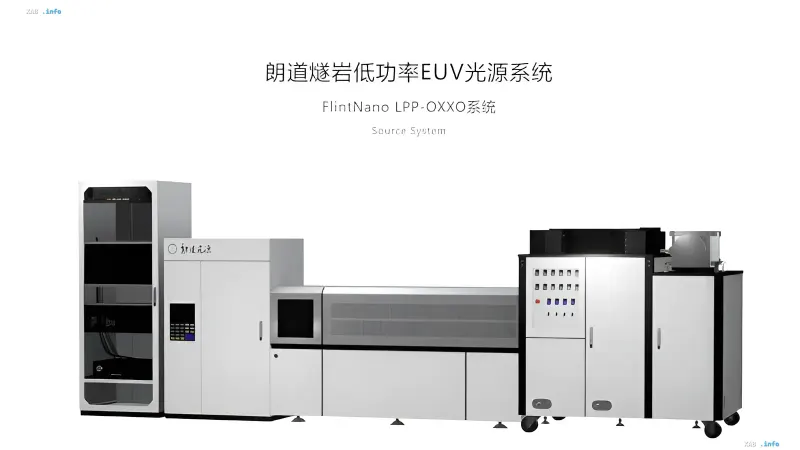
Chinese technology company Langdao Silex has publicly demonstrated a prototype of its own extreme ultraviolet (EUV) light source for EUV lithography for the first time. The presentation of the FlintNano LPP-OXXO system took place at the 26th China International Industry Fair in Shanghai. According to company representatives, about 90% of the system's components are manufactured in China, and most key assemblies were developed directly within Langdao Silex. The team behind the project includes a former ASML Holding employee, underscoring the strategic importance of the development for the Chinese semiconductor industry.
Prototype Technical Specifications
The FlintNano LPP-OXXO system is built on laser-produced plasma (LPP) technology: a high-power laser targets microscopic tin droplets, turning them into plasma that emits radiation with a wavelength of about 13.5 nm. According to specifications published by Langdao Silex, the driving laser has a power of 1000 W, the pulse repetition rate is 1–20 kHz, and energy conversion efficiency exceeds 2%. The claimed EUV output power is over 15 W, with a brightness of 100 W/(mm²·sr). The company also indicates continuous operation capability of over 100 hours, a plasma area size of 60 µm, plasma stability of 3% RMS, and energy stability of 5%. Notably, several specialized publications, citing data from Chinese researchers, cite an energy conversion efficiency of around 3.4%, which slightly exceeds the figure announced at the presentation.
Gap with Industrial Standards
A significant gap remains between the capabilities of Langdao Silex's prototype and the requirements for commercial EUV systems. Industrial lithographic systems require light sources with powers of several hundred watts capable of stable long-term operation. For comparison, ASML achieved an EUV source power of 250 W back in 2018, which enabled the transition to mass production of chips using EUV lithography. In April 2025, the Dutch company demonstrated a 1000 W source, though its commercial deployment also requires further engineering work. Thus, the 15 W claimed by Langdao Silex remains at the level of a laboratory prototype rather than an industrial solution.
Roadmap and Key Challenges
Langdao Silex states that technological feasibility has been proven for the high-power FlintMicro-LPP series, while the low-power FlintNano-LPP series is in the product development stage. Nevertheless, according to the company's own estimates, full-scale commercial production is three to five years away. The main challenges lie in increasing output power and improving long-term operational stability. In addition to the light source itself, creating a competitive EUV system will require precision optics, high-accuracy wafer positioning mechanisms, and complex system integration. ASML's systems consist of hundreds of thousands of components supplied by over 800 companies worldwide—an ecosystem that cannot be replicated overnight.
Context: DUV Already in Production, EUV is the Next Step
It was previously reported that China has already established production of less advanced lithographic systems operating in deep ultraviolet (DUV), with deliveries to major local chipmakers expected in 2026. EUV remains a significantly more complex challenge requiring progress across a range of critical subsystems. For ASML, China is an important market, accounting for about 20% of the Dutch manufacturer's annual revenue. At the same time, analysts estimate that ASML is more concerned about potential new U.S. sanctions than the current level of Chinese developments in EUV lithography. However, the public demonstration of Langdao Silex's prototype marks a symbolic step confirming that China is steadily closing the technological gap in one of the semiconductor industry's most critical spheres.