In the world of paleontology and molecular biology, an event has occurred that could overturn established scientific dogmas. A team of researchers led by Professor Steve Taylor from the University of Liverpool has presented evidence that organic molecules can be preserved in fossils for tens of millions of years. The results of this breakthrough study, published in the prestigious journal Analytical Chemistry, indicate the presence of preserved collagen in a dinosaur bone that is 66 million years old.
Discovery in South Dakota: Edmontosaurus and Its Secrets
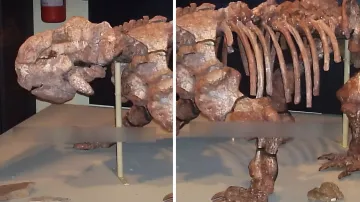
The subject of the study was a bone found in the famous Hell Creek Formation in the American state of South Dakota. The specimen belonged to an Edmontosaurus — a herbivorous dinosaur from the duck-billed family that lived during the late Cretaceous period. This animal weighed about 22 kilograms, making it a medium-sized representative among its relatives. It was in this bone that scientists discovered the amino acid hydroxyproline, which is a unique marker of collagen — the main protein that makes up the framework of bone tissue.
Verification Methods: Excluding Contamination
The main stumbling block in such studies has always been the likelihood of the sample being contaminated by modern proteins. To rule out this scenario, specialists applied advanced analysis methods, including protein sequencing and tandem mass spectrometry. These high-precision tools allowed for a detailed analysis of the sample's chemical composition. The conducted analyses showed that the discovered organic substances could not have entered the sample from the external environment during its storage or extraction. This became convincing evidence that the molecules indeed originated directly from the fossil itself.
Reinterpreting History: 30 Years of Debate
The question of the possibility of preserving proteins for tens of millions of years has been the subject of sharp scientific debate for about 30 years. The traditional view held that during the fossilization process, all organic molecules inevitably decompose and disappear. However, the new results obtained by Professor Taylor's team show that under certain natural conditions, such long-term preservation is theoretically possible. This discovery forces a re-evaluation of scientific views on the limits of preserving biological information in geological time.
The Future of Paleontology: A Molecular "Treasure"
In the opinion of experts, this find has colossal significance for paleontology. If ancient proteins can indeed be preserved in some fossils for millions of years, scientists will be able to obtain much more information about the biology and evolution of extinct animals. The authors of the study put forward a bold hypothesis: among the fossils collected and stored in museums for centuries, there may be many unstudied samples with preserved collagen. This opens up new opportunities for enriching views on dinosaurs that lived millions of years ago and for a deeper study of their biological characteristics.