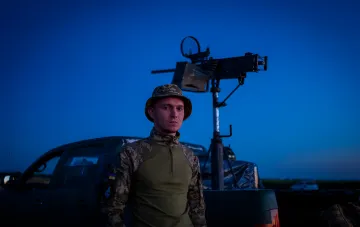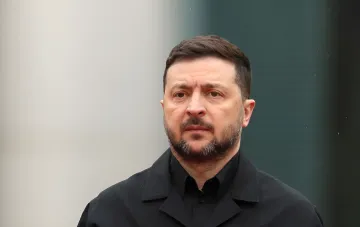
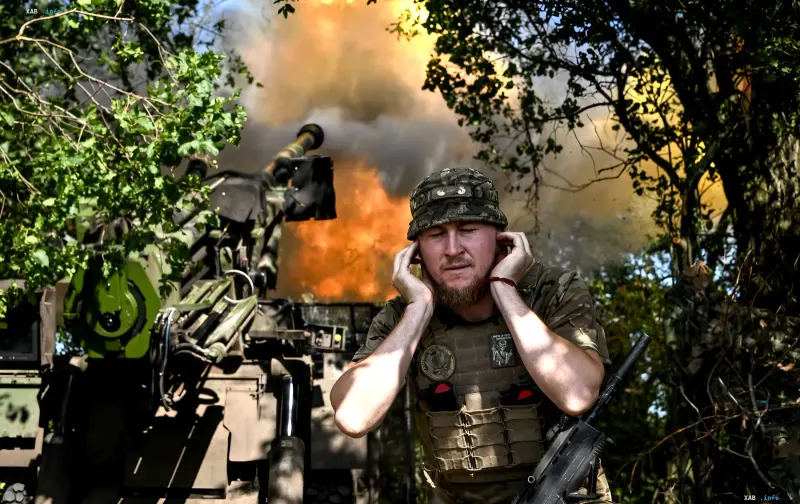
At the YES Annual Meeting 2026 conference, organized by the Viktor Pinchuk Foundation, the commanders of three Ukrainian army corps — the 2nd NSU 'Charter' Corps, the 'Azov' Corps and the Third Army Corps — were united by a single question: what will happen to the war by the end of 2026 and in early 2027. The speakers — Brigadier General Andrii Biletsky, Commander of the 2nd Corps Ihor Obolensky, and Commander of the 'Azov' Corps Denys 'Redis' Prokopenko — painted a picture in which the coming winter will become a turning point, and the outcome of the fighting will be largely determined by Ukraine's ability to shield its skies from ballistic missiles and jet-powered drones. RBC-Ukraine reports.
Two Kremlin goals and "fantastic deadlines"
According to Commander of the Third Army Corps Andrii Biletsky, Russia's military leadership has formulated two key tasks: the final capture of the Donetsk and Luhansk regions, and the conduct of economic and civilian terror aimed at breaking Ukraine's defensive potential. At the same time, Biletsky said, there is a discrepancy in timelines within the Russian leadership: the military command has set the task of completing the capture by mid-April 2027, while the political leadership demands the operation be finished "in completely fantastic deadlines" — by the start of the new 2027. It is precisely this pressure, the general believes, will determine the aggressiveness of Russian offensive operations during the autumn-winter period.
A "belt of fortress cities" and winter as the exam
Biletsky stated that the Ukrainian Defense Forces have every chance to hold the so-called "belt of fortress cities" in the Donetsk region and even improve their position on certain sections of the front: "I think within the next month we will demonstrate these improvements to the whole world." At the same time, he did not hide that the coming winter will be "very tough." The key condition for survival, he said, will be the ability to shield the Ukrainian sky from two threats: ballistic missiles and jet-powered drones such as the 'Shahed' and 'Banderol'. If the front and the rear hold, then in March–April 2027, in Biletsky's assessment, Russia will face an "existential question" about the expediency of continuing the war, since none of its strategic goals will have been achieved. "That would perhaps be the ideal moment for sustained negotiations and a sustainable peace on, if not fully, then to a significant extent, Ukrainian terms," the commander of the Third Corps emphasized.
The battlefield has "gone underground" and technology changes every two to three months
Commander of the 2nd NSU 'Charter' Corps Ihor Obolensky drew attention to the speed of technological change: "What was the case two years ago is simply not up for discussion. Technology changes — two to three months and it's a new reality." In the area of responsibility of his corps, he said, combat operations have "gone underground": Ukrainian units are already conducting flanking attacks in the underground space and using DJI drones in tunnels and shelters. "Everyone comes to us, I show them, I explain that you — the Western countries — have no experience of conducting a flanking attack underground. We already do," Obolensky noted. On air defense, he called for building a two- to three-echelon defense system together with Western partners, developing short-range missiles and working with "air-to-air" carriers capable of intercepting both ballistic missiles and jet-powered drones.
Mobilization up to 600,000 and a "climax" in September
Commander of the 'Azov' Corps Denys 'Redis' Prokopenko warned that Russia is preparing a large-scale reinforcement of its offensive, which could begin as early as after the local elections in the Russian Federation. In his assessment, by the end of September — the start of winter — the enemy is capable of mobilizing up to 600,000 servicemen, who "may already be seen on the line of combat contact in the near future, by the end of this year." By throwing in additional forces, Russia, in Prokopenko's view, will try to seize one of the cities of the Donetsk region — Dobropillia, Konstantynivka, Druzhkivka, Kramatorsk, Slavyansk or Sviatohorsk — and gain access to operational space. "We will not let them do this. The enemy has no chance of success. The losses are colossal," he declared, citing his own calculations: in July, on the 'Azov' Corps axis, the Russians lost 123 servicemen, in August — 135. September, in his forecast, will become the "climax of the summer offensive campaign," and from October, when the rains, fog and shorter daylight hours begin, the enemy will be forced to shift from the tactics of small infantry groups to the use of heavy armored vehicles.
Contradictory data
The commanders' statements contain a number of inconsistencies that are important to take into account when interpreting them. First, the deadlines for completing the task of capturing Donbas differ depending on the level of Russian leadership: the military command, according to Biletsky, is aiming for mid-April 2027, while the political leadership demands completion "by the start of 2027" — a difference of several months, but with a fundamentally different degree of pressure on the front. Second, the figure of 600,000 mobilized, voiced by Prokopenko, is his personal assessment and forecast, not confirmed data from intelligence or Russian sources; in open materials, including a Focus.ua publication on the "Putin mobilization," the specific figures for the autumn draft do not match this estimate and vary depending on the region and source. Third, the question of a possible offensive on the Chernihiv region, which is raised in a number of Ukrainian and Western analytical assessments, was not directly discussed at the YES Annual Meeting 2026 conference by the commanders of the three corps — their focus was concentrated on the Donetsk axis and the defense of the sky.
What this means for the winter of 2026–2027
The combined assessments of the three commanders add up to the following picture: the coming month (September) will be characterized by Russia's attempts to show the results of the summer campaign, October–November — by a change of tactics due to weather conditions and possible massive use of armored vehicles, and winter will become a critical test for the air defense and logistics of both sides. If the Ukrainian side holds the "belt of fortress cities" and ensures reliable air cover, then in the spring of 2027, in Biletsky's assessment, Moscow will have motivation for negotiations on terms close to the Ukrainian ones. If, however, winter losses and the inability to break through the defense do not stop the offensive, the conflict risks turning into a prolonged positional war with growing economic pressure on both sides. In any case, all three commanders emphasize, without large-scale support from Western partners in the field of air defense and the development of new classes of missile systems, Ukraine will not be able to ensure the necessary level of air protection in conditions where Russia is simultaneously expanding both its ballistic and drone arsenal.