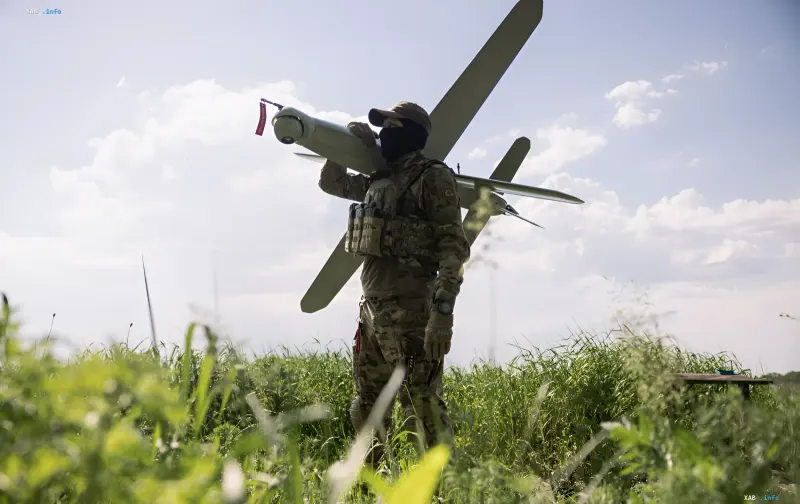
Robert Brovdi, commander of the Unmanned Systems Forces (USF), known by the callsign “Madjar,” stated that during the “Crimean Breaker Off” operation, drone units struck 374 energy nodes in Crimea and across the other temporarily occupied territories over a two-month period. According to him, the campaign ran from July 6 to September 9, 2026, and as many as 34 energy nodes were hit in just the first week of September — in Crimea, and in the south and east of the occupied regions. This was reported by RBC-Ukraine, citing the commander.
Course of the operation and geography of the strikes
Among the successfully struck targets, according to “Madjar,” are the Luhansk Thermal Power Plant in Shchaste, a number of 110–330 kV substations in Donetsk, Luhansk, Zaporizhzhia and Kherson oblasts, as well as railway traction substations. In Crimea, several gas distribution stations were separately hit — in particular “Yevpatoria,” “Nyzhnihorskyi” and “Azovske” — along with the enemy’s mobile firing groups. Thus, the strikes were not only energy-related but also logistical in nature, affecting railway infrastructure.
Which units were involved
According to the command’s statement, the operation involved USF units: the 414th “Madjar’s Birds” Brigade, the 412th Nemesis Brigade, the 20th “K-2” Brigade, the 427th “Rarok” Brigade, as well as the “Phoenix” grouping of the State Border Service of Ukraine. At the start of the campaign, the same data indicate that the “USF Birds” struck a key node of the “Kuban — Crimea” energy bridge, through which electricity from mainland Russia is supplied to the occupied peninsula.
Objectives of the campaign
The objective of the operation, as formulated by the command, is to systematically deprive the occupiers of electricity and communications, creating a logistical and fuel shortage. According to “Madjar,” in August alone the USF confirmed the destruction of 240 energy nodes in the occupied territories, making August the most productive month of the campaign in absolute figures.
Contradictory data
Some sources covering the same campaign use a more categorical phrasing: the headlines of a number of publications state that Crimea has been “permanently disconnected” from Russia’s power grid. This difference in emphasis is important to note: the USF command characterizes the operation as a prolonged, ongoing series of strikes on 374 nodes over two months, whereas individual headlines portray a picture of a completed full disconnection. Moreover, all quantitative figures (374, 34 and 240 nodes) are cited from a single source — the USF commander — and, at the time of publication, have not been confirmed by independent fact-checking from the enemy or by international observers. In parallel, in the context of USF actions in the Sea of Azov, there were reports of attacks on vessels of Russia’s “shadow fleet” and on air defense assets, which broadens the picture of the campaign beyond purely energy infrastructure.