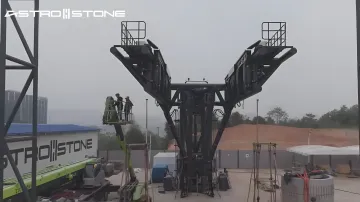
An image of the aft section of the CZ-9 super-heavy rocket has appeared on the Chinese social network Weibo. The snapshot clearly shows a section with bays for installing 30 main engines. Judging by the nature of the shot and the quality of execution, this is a structural mockup, presumably prepared for the Airshow China 2026 exhibition scheduled for December 7–13. It is quite possible that the organizers will present updated information about the project and its technical parameters at this very event.
Layout and Dimensions: Similarity to Super Heavy and Noticeable Superiority in Diameter
Externally, the aft section of CZ-9 resembles the American Super Heavy system in terms of engine layout, but it is a fundamentally different rocket. Moreover, it is larger in its key dimension: the structure's diameter is 10.6 meters compared to 9 meters for Super Heavy. In its current configuration, the CZ-9 features a reusable first stage and two expendable stages. The propellant scheme also differs: the first two stages will run on methane, while the third will use hydrogen.
YF-215 Engines: Full Flow Staged Combustion Cycle
The section shown in the photo is planned to accommodate 30 YF-215 engines. They use methane and oxygen in a full flow staged combustion cycle and are expected to develop a thrust of over 200 tons each. According to available data, the engines are already undergoing hot-fire testing. In terms of thrust level, the YF-215s approach the American Raptor engines used in the Starship program, making them one of the key elements of competitiveness for China's super-heavy system.
Lunar Program and Prospects for a Fully Reusable System
The primary task of the CZ-9 at the initial stage is to support China's lunar program. The rocket is planned to be used for delivering payloads of at least 50 tons to the Moon, which significantly exceeds the capabilities of the American SLS system. In the longer term, a fully reusable super-heavy transport system is expected to be created on the basis of CZ-9, along with other rocket variants designed for various tasks. Thus, the publication of the mockup on Weibo can be viewed as an indicator that the project is entering the stage of public demonstration and specification refinement.