November for dahlias is a time when the last blooms may still delight with color, but the first night frosts are already capable of damaging stems and foliage in a single night. It is during this period that gardeners face a key challenge: preventing the freezing of the tubers, upon whose condition the spring regeneration of the plants directly depends. Dahlias belong to heat-loving perennial crops whose underground organs cannot withstand sub-zero soil temperatures. According to recommendations from the Royal Horticultural Society (RHS), in regions with cold winters, the safest solution is digging up the tubers and storing them in a frost-free room. In areas with mild climates, dahlias are sometimes left in the open ground, covered with a thick layer of dry mulch, but even such shelter does not guarantee complete plant survival. For most regions with autumn rains and heavy clay soils retaining moisture around the roots, the safer option remains digging up the tubers before the ground freezes.
Temporary Protection Against Brief Frosts
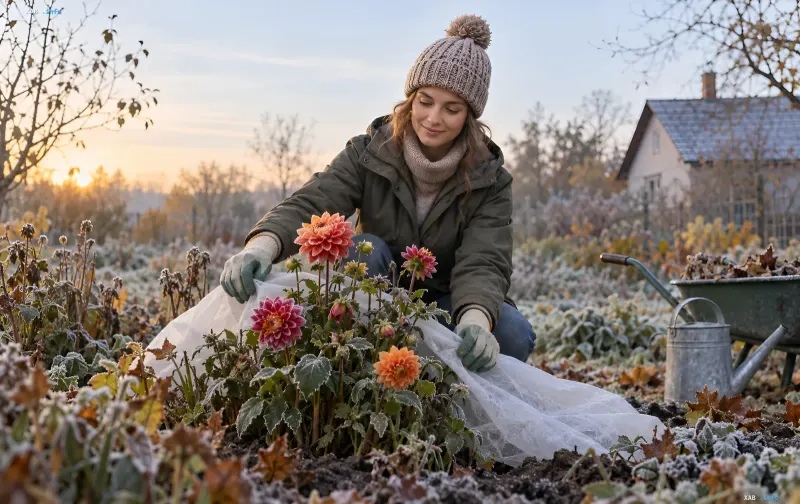
If dahlias are still blooming in early November, they can be temporarily protected from brief night cooling. Plant protection specialists advise using garden fleece or another light covering material. In the absence of specialized cover, an old bedsheet or other breathable fabric is acceptable. However, it is strictly not recommended to cover plants with plastic film directly over the foliage: the material poorly passes air and promotes condensation accumulation, leading to tissue rotting. It is important to understand that temporary shelter helps survive brief frosts, but does not protect tubers from prolonged cold and soil freezing. This is merely a "respite" rather than a replacement for proper indoor wintering.
When and How to Dig Up Tubers
Most often, dahlias are dug up after the first frosts, when the leaves darken, wilt, and lose turgor. However, as explained by Washington State University Extension specialists, the first frost is not a mandatory condition for digging up mature tubers. The main thing is to give plants enough time to form underground organs. In November, one should focus primarily on the state of the above-ground part and the weather forecast. It is advisable to choose a dry day without heavy rain for digging, when the soil is not too wet. During work, it is important to preserve not only the tubers themselves, but also the points where they connect to the stem base: it is in this area that the buds develop from which new shoots will grow in spring. The Ask Extension gardening platform advises carefully digging up tuber clumps, cleaning them of soil, and drying them before winter storage. It is not mandatory to divide the tuber clump into separate parts immediately — this can be done in spring when viable buds become more noticeable. If several varieties are grown on the plot, each clump should be labeled to avoid mixing up plants before spring planting.
Rules for Winter Storage of Tubers
Even properly dug tubers can spoil due to excessive moisture, drying out, or inappropriate temperature. According to recommendations from the American Dahlia Society, the optimal storage temperature is approximately 4 to 7 °C. It must be maintained stably: freezing damages tubers, and excessive warmth causes premature sprouting. Dried tubers are laid out in wooden or cardboard boxes and sprinkled with vermiculite, wood shavings, or sawdust. The filling material should not be wet, while an overly dry environment leads to gradual moisture loss and shriveling of the tubers. Both freezing and condensation accumulation are unacceptable in the boxes. After storage placement, dahlias should not be left unattended until spring: University of Wisconsin-Madison Extension recommends checking the tubers about once a month. If tubers have started sprouting prematurely, it is necessary to check the room temperature and adjust conditions.
Dahlias in Containers: Special Precautions
Plants grown in pots or large containers require no less frost protection than those growing in open ground. According to Swan Island Dahlias nursery specialists, tubers in pots are more susceptible to cold influence because the soil freezes not only from above, but also along the sides of the container. Such plants can be left to overwinter directly in pots provided appropriate conditions are met: moving them to a heated room or at least one protected from direct frost. If container dahlias are still blooming, the pot can be temporarily moved to a protected spot before a brief frost. It is strictly not recommended to leave planters on an open balcony all winter: even if the above-ground part of the plant has already died off, soil freezing in the container can completely destroy the tubers.
Following these simple rules — from timely temporary shelter to regular storage condition monitoring — allows dahlias to be kept in good condition until next spring and ensures abundant blooming already in May–June 2027.