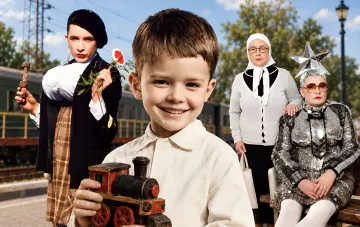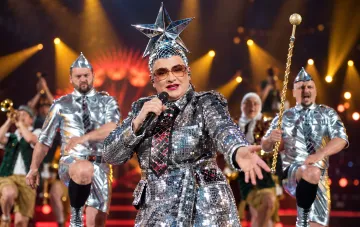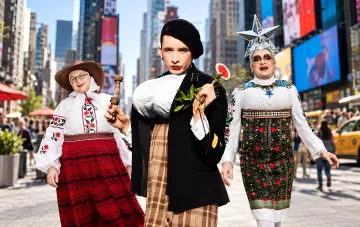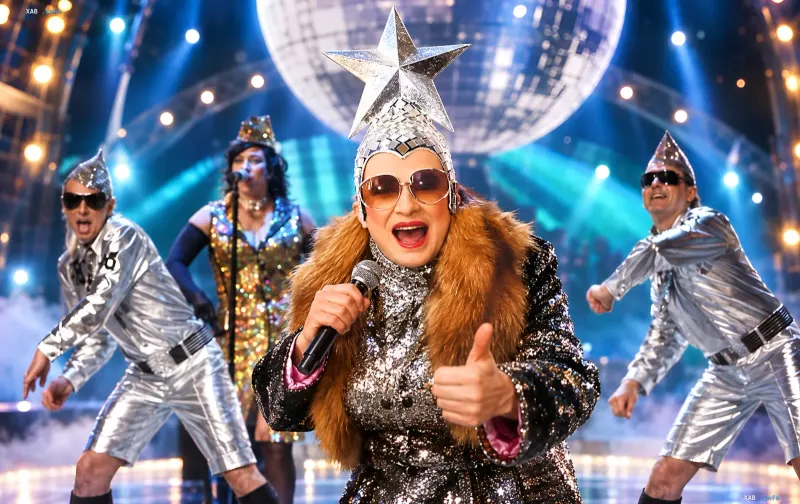
In 2007, the persona of Verka Serduchka, created by Ukrainian artist Andriy Danylko, made him one of the most recognizable participants in Eurovision history. By the time of the contest, the character was already popular in Ukraine and Russia thanks to humor, a distinct speaking manner, flamboyant costumes, and hit songs. For the international competition, Danylko prepared the dance track «Dancing Lasha Tumbai» — a mix of English phrases, Ukrainian words, and intentionally absurd sound combinations. The performance on May 12, 2007, in Helsinki earned Serduchka 235 points and second place: the winner was Serbia's representative Marija Šerifović with the song «Molitva» (268 points), while the Russian group Serebro took third place. However, after the contest ended, viewers discussed not so much the silver costume with a large star on its head and the choreography, but rather a few words from the chorus.
How «Lasha Tumbai» Was Heard as «Russia Goodbye»
In the chorus, Danylko repeatedly chanted the English phrase «I want to see», followed by the combination «Lasha Tumbai». For most international listeners, this was simply an unusual sound combination. The Russian audience, according to reports at the time, heard a different phrase in it — «Russia Goodbye». The artist himself denied singing a farewell to Russia, and the scandal quickly spilled beyond the music contest: some Russian media and commentators perceived the performance as a hidden political attack, and some called for a boycott of Serduchka. Despite the controversy, the track remained the artist's main international hit, and Danylko performed it with the original chorus for a long time.
What the Artist and Researchers Said
Explanations of the chorus's meaning changed over time. Initially, Danylko called «Lasha Tumbai» a Mongolian saying supposedly meaning «whipped cream», and in conversations with Ukrainian journalists, he clarified that he had been told it translated to «churn butter», though he did not consider this explanation essential. In 2022, he explicitly called the combination «abracadabra» — a fictional set of sounds without specific meaning, into which listeners began reading various interpretations. The linguistic version with the Mongolian translation was tested by researchers: an article from the Center for Russian, East European, and Eurasian Studies at the University of Michigan noted that the explanation about «whipped cream» had no convincing linguistic support, while the chorus genuinely sounded like «Russia Goodbye» to many.
From Scandal to Direct Lyrics
The history of the performance was examined by historian and University of Victoria (Canada) professor Serhy Yekelchyk in his 2010 academic article «What Is Ukrainian about Ukraine's Pop Culture?: The Strange Case of Verka Serduchka». He viewed the Eurovision scandal as part of a broader conflict of cultural identities between Ukraine and Russia, noting that prior to 2007, Serduchka was well-received in both countries, but after the performance, the character — previously seen primarily as a comedic artist — found herself at the center of a political dispute. Verka Serduchka was an unusual representative of Ukrainian pop culture: her songs combined the Ukrainian language, Russian, surzhik, domestic humor, and Estrada show elements, making the image recognizable while simultaneously sparking debates about how Ukraine should be represented on the international stage.
The turning point came after February 24, 2022, when Russia launched a full-scale invasion of Ukraine. The artist decided to leave no room for double interpretations of the chorus: on March 8, 2022, Andriy Danylko announced that from then on he would no longer sing «Lasha Tumbai», but «Russia...». At Eurovision 2023, he performed the composition with this exact direct phrasing, turning the once-absurd sound combination into an open political gesture.