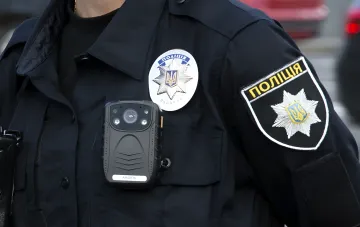
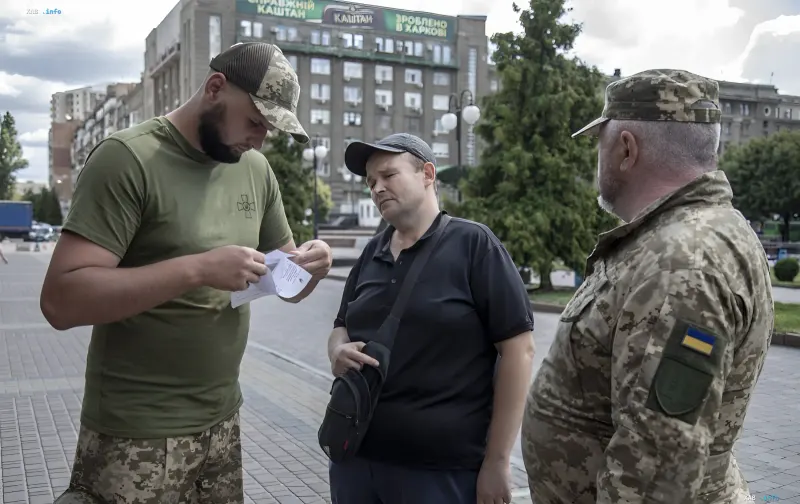
On September 9, an incident involving the activities of employees of the Territorial Center for Recruitment and Social Support (TCC) took place near one of the city's gymnasiums in Dnipro. During a document check of a man of conscription age, a conflict involving civilians broke out, in which pepper spray was used. According to the school principal, the substance reached the school grounds, where a physical education lesson was in progress at the time. This is reported by RBC-Ukraine, citing the Dnipropetrovsk Regional TCC and Social Support Center.
Timeline of events according to the military registration office
According to the regional TCC and Social Support Center, on the day of the incident a notification group, together with law enforcement officers, stopped a man of conscription age to check his documents. The citizen refused to provide them, fell to the ground and began shouting. Passers-by — men and women with children — started approaching the scene. The military registration office claims that the civilians behaved aggressively and threatened the servicemen. To avoid further escalation, the group decided to leave the scene. It was at this moment, according to the TCC, that pepper spray from a canister was used by civilians from the crowd toward the official vehicle as the soldiers were getting inside. An internal investigation has been launched at the military registration office over this incident, and a report to the police is planned following its results.
Consequences for the school and students
Gymnasium principal Irina Nesterenko confirmed that the dispersed spray reached the area where the children were during the PE lesson. After the incident, parents took the students home. As of the evening of September 9, no students had sought medical attention. However, one of the teachers sustained scratches. An investigative team is working on the school grounds, interviewing witnesses and gymnasium staff to establish the full picture of what happened.
Contradictory data
The versions of the TCC and the police diverge on key details. The military registration office insists that the pepper spray was used by civilians from the crowd at the moment the soldiers were getting into the official vehicle, i.e., after the direct pursuit had ended. The police, for their part, note that there was no deliberate spraying of the children, and that the spray from the canister was "carried by the wind during the pursuit of the man." Thus, law enforcement ties the moment of the substance's release to the phase of the chase, whereas the TCC shifts it to the moment of getting into the vehicle. Moreover, it is not clarified who exactly was in possession of the canister at the time of the incident — the man being detained, one of the passers-by, or an employee of the notification group. These discrepancies make it impossible to definitively attribute the source of the spray release until the internal investigation and the work of the investigative team are completed.
Context: a series of incidents around the TCC
The Dnipro case is not an isolated one. Recently, a number of high-profile incidents related to the work of TCC employees have been recorded in Ukraine. In Lviv, law enforcement officers initiated an internal review following a conflict during notification measures, in which a TCC serviceman pushed a woman. The regional military registration office then spoke of "manipulation," claiming that the citizen was obstructing mobilization and had herself used tear gas. In addition to individual conflicts, large-scale inspections of military registration office activities have revealed systemic abuses: as a result of inspections at the Zakarpattia TCC, criminal cases were opened and the leadership was changed due to the violations identified. The Dnipro incident, in which pepper spray ended up in close proximity to children, once again raises the question of the procedures for using special means in conditions of a dense gathering of civilians, including minors.