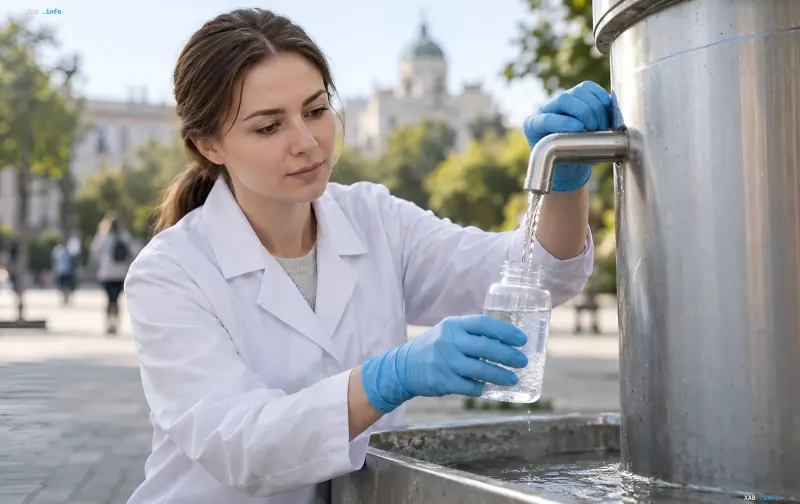
In 2026, the State Service of Ukraine on Food Safety and Consumer Protection conducted a nationwide, large-scale inspection of drinking water quality. The service's laboratory units tested 10,463 samples: 8,575 from centralized water supply sources and 1,888 from non-centralized ones. According to the agency's report published in November 2026, a significant portion of the samples failed to meet sanitary standards, with excessive nitrate levels leading the list of typical violations.
Scale of Inspections: Nearly 9.5 Thousand Facilities Under Control
During the reporting period, territorial bodies of the State Service inspected 9,450 water supply facilities, including 420 centralized and 881 non-centralized water supply enterprises. Violations of sanitary legislation were recorded at 907 facilities: 351 in the centralized network and 556 in the non-centralized sector. Specialists also specifically covered pump rooms, packaged drinking water distribution points, shaft wells, and spring captages. In particular, 5,124 shaft wells and two spring captages were inspected. Out of four packaged drinking water production companies, violations were found at one.
Nitrates: A Hidden Threat in Every Fifth Well and Borehole Sample
A separate block of inspections focused on nitrate content in water. Out of 16,614 samples from centralized water supply, standard excesses were recorded in 55 cases (0.33%). The picture for non-centralized sources is fundamentally different: out of 1,838 samples, deviations were found in 394, which is 21.4%. Overall, across centralized networks, 1,387 samples (16%) did not meet sanitary legislation requirements, while deviations in non-centralized sources were recorded in 392 samples. The State Service emphasizes that a visually clean well or borehole does not guarantee water safety and requires regular laboratory testing for sanitary-chemical and microbiological parameters.
Nine Cases of Methemoglobinemia in Children, Including One Fatality
Excessive nitrates pose a particular danger to young children. In 2026, nine cases of water-nitrate methemoglobinemia in children under three years of age were registered in Ukraine, including one fatality. Methemoglobinemia is a condition where nitrates convert into nitrites and bind hemoglobin, depriving the blood of its ability to carry oxygen. For infants and children under three, this is especially critical because their bodies are less resilient to the oxidative effects of nitrites. The agency reminds that boiling does not eliminate chemical contamination: it reduces microbiological risks, but does not remove nitrates from water.
Systemic Problems: From Missing Balance-Holders to Worn-Out Equipment
Among the typical violations identified during inspections of centralized facilities, the State Service highlights poor sanitary and technical conditions of structures and equipment, lack of proper laboratory control, and insufficient provision of water disinfection agents. For non-centralized sources, additional problems remain the lack of responsible balance-holders and sanitary passports, improper cleaning and disinfection, as well as the absence of water softening and iron removal systems. Experts advise consumers to regularly check water from individual sources and pay attention to laboratory test results for water from pump rooms and distribution points.
Context: Low Water Levels and Accidents Amplify Risks
The 2026 inspections took place against the backdrop of persistent low water levels, which, according to specialized agencies, increase risks for water supply in certain regions. The most difficult situation developed in the Dniester basin, where in September 2026 an historical record was set—water inflow into the reservoir turned out to be the lowest in all years of observation. Concurrently, due to accidents, water pipeline damage, and the consequences of attacks on infrastructure, water periodically disappears in Ukrainian homes. The Public Health Center had previously explained to the population the procedure for actions in such situations and pointed to safe alternative sources. The combination of these factors makes the results of the State Service inspections not just statistics, but a practical guideline for millions of water supply users.