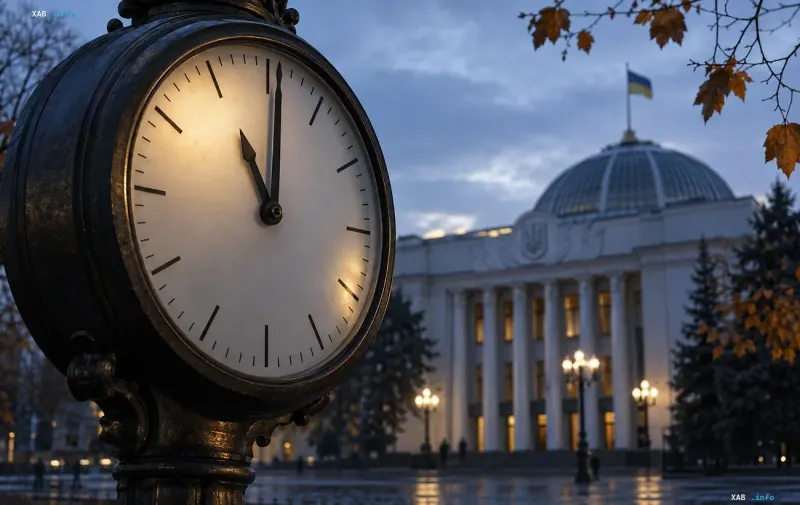
Every autumn, Ukrainians once again face the familiar but irritating ritual of changing the clock hands. In 2026, as in previous years, all regions of the country will traditionally switch to so-called winter time. The paradox is that formally the parliament voted back in 2024 for the complete abolition of these seasonal transitions, yet the law has never taken effect. We look into why the cancellation did not happen, which regulatory act currently determines time in the state, and on exactly which night in autumn 2026 the clocks will be "rolled back."
Why the question of clock change does not subside
The topic of seasonal time change has been raised in Ukrainian society for far from the first year — by ordinary citizens, public figures, and politicians alike. According to a number of specialists, regular shifts disrupt people's biological rhythms and negatively affect physical and psychological well-being. For a long time, experts and members of parliament could not agree on which time to "fix" — winter or summer. The key difficulty lay in the significant east-west extent of Ukraine: living the whole country in a single time zone throughout the year inevitably gives rise to nuances. In the end, most specialists agreed that giving up the clock change in Ukraine is quite realistic.
What the Verkhovna Rada decided and why the law is not in force
Following lengthy discussions, in July 2024 the Verkhovna Rada adopted bill No. 4201, initiated by then-parliament speaker Ruslan Stefanchuk. According to the document, there should no longer be traditional seasonal transitions "to another time." At the same time, the final provisions state that the law enters into force the day after its official publication — that is, after signing by the head of state. The document was handed to President Volodymyr Zelenskyy for signature on 21 August 2024. However, as of 25 September 2026, it has still not been signed or published, and therefore has not entered into force.
Contradictory data
Here a notable inconsistency arises between positions and regulatory documents. On the one hand, parliament adopted a decision to abolish the seasonal clock change, and in public discourse the law is often presented as already "adopted." On the other hand, it has no legal force: until the president signs and publishes the document, the state continues to be guided by Cabinet of Ministers Resolution No. 509 of 13 May 1996 "On the procedure for calculating time on the territory of Ukraine." It is precisely this resolution that established Kyiv time (the second time zone) and set a clear schedule for the seasonal clock change. Thus, the formal will of the legislator to abolish and the actual practice, in which the clocks are still changed, exist in parallel, and resolving this contradiction depends exclusively on the signature of the head of state.
Exactly when Ukraine will switch to winter time in autumn 2026
Since the bill adopted by parliament has not been signed or published, the country to this day operates under the rules of CMM Resolution No. 509. Accordingly, the switch to winter time in 2026 will take place on the night from Saturday to Sunday — from 24 to 25 October. The clock hands will need to be turned back by one hour, which will give you the chance to sleep an hour longer. This is a standard procedure that citizens have gone through for many years, despite repeated promises to abolish it.
What this means for citizens
For Ukrainians, autumn 2026 will bring no novelties: time will change according to the familiar scenario, and the debate over whether to change the clocks at all will continue. Experts remind that the question of whether the clock change allows saving electricity remains a subject of separate studies, and public attitude toward this practice remains mixed. Until bill No. 4201 is signed and published, the 1996 resolution remains the only valid reference point, and every October the country will again "roll back" the clocks.