On the shore of the Donuzlav lagoon, in the area of occupied Novoozernoye, new coastal infrastructure has been recorded — dry docks (ellings) whose purpose, according to OSINT community assessments, is linked to the storage of uncrewed boats or maritime drones. This is evidenced by satellite imagery of the area published in open sources. The structures are located in close proximity to the water, making them potentially suitable for the basing, maintenance, and preparation of small maritime vehicles for deployment into the Black Sea.
New coastal infrastructure on the Donuzlav
According to OSINT analysts, this is a deliberate construction of coastal facilities in the Novoozernoye area. Dry docks are specialized structures for storing and servicing watercraft, and their appearance in the coastal zone of occupied Crimea is viewed as part of the expansion of military infrastructure. Satellite imagery shows that the facilities are ready or that work on them has been completed, indicating a practical rather than declaratory phase of construction.
Purpose of the dry docks: OSINT assessments
The key conclusion of analysts is that the new dry docks are most likely intended for uncrewed boats. At the same time, open sources do not record any active combat use of such vehicles by Russian forces in this area. The emergence of the corresponding structures, experts assess, may indicate preparations for testing this class of weapon and the creation of the necessary infrastructure for further deployment. Thus, the dry docks near Novoozernoye may be part of Russia's preparation for future use of uncrewed boats in the Black Sea.
Contradictory data
There are notable discrepancies between various assessments. On the one hand, the OSINT community directly links the purpose of the dry docks to the storage of maritime drones, relying on satellite imagery and the logic of the facilities' placement. On the other hand, no official confirmation of such a purpose has been published by Russian authorities, and no active combat use of uncrewed boats in the Donuzlav area is recorded — meaning the link between "structure — specific weapon" remains probabilistic rather than documented. Additionally, a contradiction arises in the assessment of Crimea itself: Ukrainian Navy spokesperson Dmytro Pletenchuk stated in August that occupied Crimea has effectively ceased to be a full-fledged base for the Russian fleet, while at the same time the construction and use of the island's military infrastructure, including new coastal facilities, continue. These two positions — "Crimea is not a full-fledged fleet base" and "Crimea continues to be used for military purposes" — coexist and require cautious interpretation.
Crimea's status as a fleet base
The context set by the August statement of Ukrainian Navy spokesperson Dmytro Pletenchuk indicates that, in his assessment, occupied Crimea has effectively ceased to be a full-fledged base for the Russian fleet. At the same time, Russia continues to use the island for military purposes, in particular for the placement and support of military infrastructure. The construction of dry docks in the Novoozernoye area fits precisely into this second line — the development of coastal facilities that may service a new class of maritime means, even if the large fleet on the peninsula has, according to Kyiv's assessment, been withdrawn or limited.
Context: the development of maritime drones
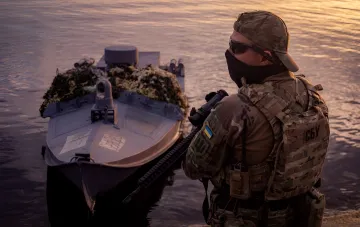
The emergence of coastal infrastructure for uncrewed vehicles fits into a broader trend in the development of maritime drones, which is discussed in open sources: from the development of uncrewed boats for the fleet to their demonstration at specialized exhibitions, including the "Flot-2026" (Fleet-2026) salon in Kronstadt. In this light, the dry docks near Novoozernoye can be viewed as part of the preparation for testing and possible deployment of this class of weapon in the Black Sea, although their exact combat use and commissioning timelines are not confirmed in open data.