Ukraine’s integration into the European energy market opens up strategic opportunities not only for Kyiv but for the entire European Union. This was stated by DTEK’s Director of Strategy, Ivan Helyuk, in a column for LIGA.net, as cited by RBC-Ukraine. In his words, Ukraine is no longer merely a “candidate” for joining the pan-European energy space, but a full-fledged participant capable of offering the continent new capacity, technologies, infrastructure, and, especially valuably, unique practical experience in managing an energy system under conditions of chronic crisis pressure.
Timeline: from synchronization to full membership
The key stage of integration was the synchronization of Ukraine’s energy system with the continental European grid, completed in 2022. This technical step effectively made Ukraine part of a single European energy loop. The final institutional stage was Ukrenergo obtaining the status of a full member of ENTSO-E — the European network of transmission system operators — at the end of 2023. Thus, by 2026, Ukraine is no longer “on the threshold” of the European market but operates within it, although, as Helyuk emphasizes, the next logical step — deepening integration through the development of common electricity markets, attracting joint investments, and coordinating strategic planning — still lies ahead.
Mutual benefit: who needs whom
One of the central theses of Helyuk’s column is that the reliability of energy supply has ceased to be an exclusively national issue. During periods of generation shortage, Ukraine imports electricity from European countries, while at times when neighboring systems face constraints, the Ukrainian energy system, in turn, is able to support them. According to the expert, this two-way substitutability turns integration from one-sided “aid” into a full-fledged market mechanism in which each side simultaneously acts as both a consumer and a provider of reliability.
Experience of operating under pressure as a competitive advantage
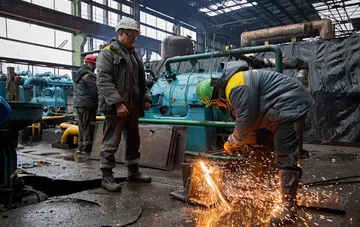
Helyuk highlights as a special, hard-to-replicate advantage of Ukraine its many years of practical experience in operating the energy system under constant external pressure. In recent years, Ukrainian energy professionals have developed, in his assessment, skills for rapidly adapting the system to emergency scenarios, localizing problems, and promptly restoring power supply. This experience, which has no analogues in “peaceful” European systems, makes Ukrainian infrastructure more resilient and flexible, and Ukraine itself — an attractive partner for the EU, which is seeking to enhance its own energy resilience.
Specific DTEK projects: from storage to wind generation
To increase the flexibility of the energy system, DTEK is implementing a number of technological projects. In particular, together with the American company Fluence, the group has commissioned six energy storage systems with a total capacity of 200 MW. In parallel, construction is underway on a digital substation and a 500 MW wind power plant. These projects, by the company’s design, are aimed at creating a modern, digital, and low-carbon energy infrastructure capable of meeting the requirements of the European market while ensuring domestic reliability.
The broader meaning of integration
“This is not only about Ukraine joining the European market, but also about the opportunity to strengthen Europe with solutions that are already being implemented in Ukraine today,” Helyuk summarizes. Previously, DTEK CEO Maksym Tymchenko had formulated the same idea in a more concise form: at the current stage, investments in Ukrainian energy are effectively investments in Europe’s energy security. Thus, the energy integration of Ukraine and the EU in 2026 has ceased to be an exclusively political gesture and has become a concrete economic and technological project with measurable parameters — from megawatts of storage to megawatts of wind generation.