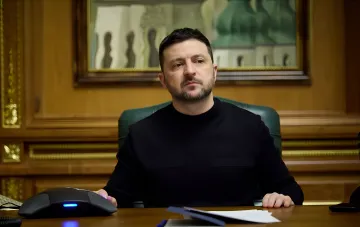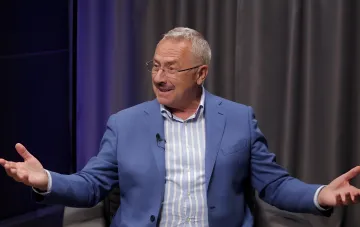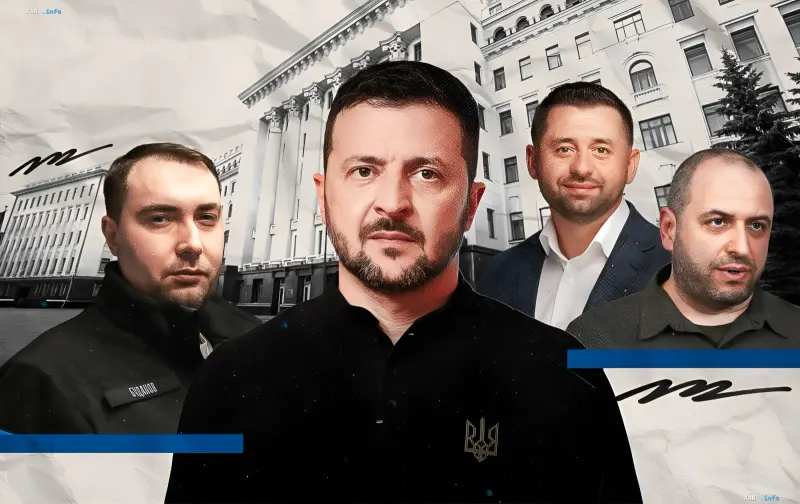
Kyiv, August 17, 2026. — Following massive personnel reshuffles that shook the Ukrainian government in early 2026, the political landscape around President Volodymyr Zelenskyy has undergone fundamental changes. The era when one man — Andriy Yermak — effectively performed the functions of a "vice-president" and controlled all key processes is irrevocably in the past. Today, influence at the top of the power structure is not concentrated in one pair of hands but is fragmented among several major players, each controlling their own sector of responsibility. The XAB.info editorial board has analyzed the new architecture of power in Kyiv.
Power Vacuum and the Collapse of the "Single Center"
The dismissal of the Head of the President's Office (PO) Andriy Yermak in late autumn 2025 created an unprecedented vacuum of influence around Volodymyr Zelenskyy. Yermak, who, according to the president himself, "came with me and will leave with me," was not just an advisor but the main filter of information and curator of all initiatives. With his departure, the unofficial position of "vice-president," which he held de facto, also disappeared.
Sources in the president's inner circle note that the process of filling this vacuum was not without conflict. "Everyone was united against Yermak; in that sense, he united everyone. When he was gone, everyone started gradually uniting against each other," notes a political scientist close to the administration. If there was a clear vertical before, today we observe a system of checks and balances where every top manager strives to expand their zone of responsibility.
Davide Arakhamia: Architect of Domestic Policy and Personnel Decisions
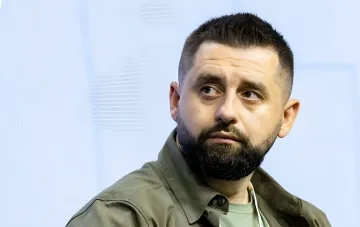
Against the backdrop of the collapse of the unified team, Davide Arakhamia, head of the "Servant of the People" faction, came to the forefront as a key figure in domestic politics. He was considered the unofficial leader of the anti-Yermak "fronde" in previous years; however, according to sources, relations between him and the president have now stabilized. Arakhamia has taken responsibility for the parliamentary agenda and personnel reshuffles in the government.
Although Arakhamia was actively involved in the recent reboot of the Cabinet of Ministers, sources in the PO clarify that he was not the sole architect of these decisions. For example, the appointment of Serhiy Koretskyi as Prime Minister was an initiative of Zelenskyy himself, who had known the politician for a long time from working at "Naftogaz." Nevertheless, Arakhamia managed to ensure the appointment of "his own" people to key posts: Vitaliy Kim headed the Ministry of Veterans, Vitaliy Bezgin became the Minister for Communities, and Andriy Butenko became the Minister of Education.
Special attention in the corridors of power is paid to Arakhamia's role in the dismissal of the Minister of Defense, Mykhailo Fedorov. The version that it was the faction speaker who initiated this resignation seems plausible, given their long-standing strained relations. "Many of our people eventually grow attached to their chairs..." comments a source in Arakhamia's circle, hinting at Fedorov's unwillingness to submit to the general strategy.
The New Triad: Umerov, Budanov, and the "Old Guard"
While Arakhamia controls parliament and domestic politics, other spheres of responsibility have passed to other influential figures. Rustem Umerov, holding high posts in the security block, has taken on issues related to security and the coordination of intelligence services. Kyrylo Budanov, as the head of the GUR, has retained his influence in military intelligence and strategic planning issues, remaining one of the few who has direct access to the president on military matters.
Interestingly, Zelenskyy is still influenced by his old comrades, as well as the president's wife. However, as one politician from the inner circle notes, the nature of these relationships has changed. "The president can say to one of ours: 'well, I'm telling you as a friend...' — but it's clear that he doesn't go fishing with him." In the midst of the Mindichgate, Zelenskyy stated: "The president cannot have friends." This phrase, said then regarding Timur Mindich, soon became prophetic regarding Andriy Yermak as well.
Contradictory Data
The question of who exactly is the president's main advisor today causes disputes among analysts and sources in Kyiv. On the one hand, many political scientists call Davide Arakhamia the de facto "second person" in the state, given his control over parliament and his role in forming the government. On the other hand, sources in the President's Office insist that Zelenskyy consciously avoids the emergence of a single dominant ally, preferring to personally oversee key areas and rely on collective decision-making. Thus, the version of a "new Yermak" may be premature, as the power system was rebuilt precisely to prevent the concentration of influence in one pair of hands.