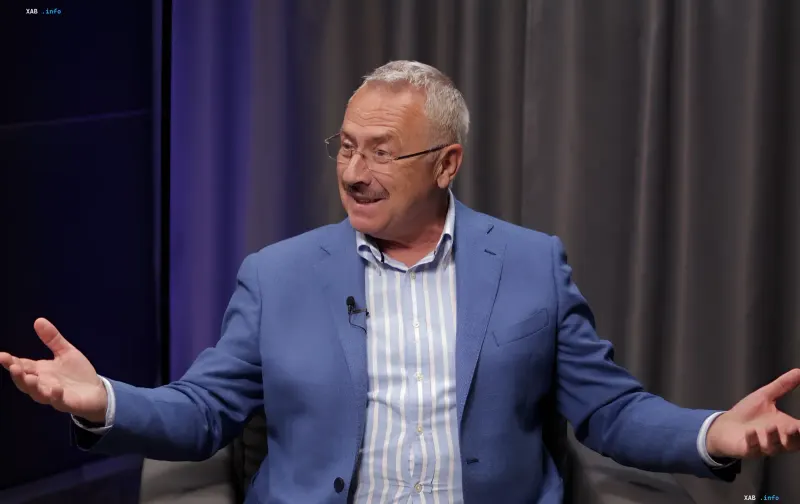
To mark the 35th anniversary of Ukraine's Independence, RBC-Ukraine has launched a major special project dedicated to the people who built the state's legal and political architecture. The focus is on Leonid Kuchma and his decade in power. One of the "fathers" of the 1996 Constitution, former Justice Minister Serhiy Holovaty, gave an open interview in which he re-evaluated the era of "Kuchmism," calling it not a dictatorship, but an autocracy with a system of checks that saved the country from a return to the Soviet dead end.
Decrees against the "Permafrost"
Holovaty emphasizes that the period of Kuchma's presidency cannot be assessed one-sidedly. It was a time when the head of state held the helm under conditions where the Verkhovna Rada of the 1st convocation was dominated by an absolute communist majority — the so-called "Group 239". The communists denied the very idea of private property, making any reforms in the classical sense impossible.
It was under these conditions, while resting at a sanatorium in Truskavets, that Holovaty devised a legal mechanism that saved the Ukrainian economy. He proposed to the Speaker, Ivan Plushch, to implement the institute of delegated legislation. On November 18, 1992, parliament adopted a resolution granting the government the right to issue decrees with the force of law. This allowed Kuchma and Viktor Pynzenyk to "break the permafrost" of the Soviet economy and prepare the ground for the introduction of the national currency — the hryvnia.
The Constitutional Agreement and the path to Europe
After Kuchma's victory in the 1994 elections, the political system remained Soviet, and the composition of the Verkhovna Rada of the 2nd convocation was again "red-pink". To overcome the deadlock, Holovaty proposed concluding a Constitutional Agreement between the President and Parliament. Signed on June 8, 1995, this document introduced a temporary super-presidential form of government and obliged the parties to adopt a new Constitution within a year.
According to Holovaty's memoirs, the document was sewn together by hand with surgical instruments, and the yellow-and-blue ribbons had to be requested from the Swedish embassy. The most important moment was the recognition of this agreement by the Venice Commission as a "mini-constitution" that broke the back of the Soviet system. This opened the way for Ukraine to join the Council of Europe, and on November 9, 1995, a solemn ceremony for raising the Ukrainian flag took place in Strasbourg.
The "Constitutional Night" and the Kremlin vector
In the process of creating the 1996 Constitution, there was a sharp struggle between the European and Asian (Kremlin) vectors. Russia and Belarus had already adopted a model with a weak parliament and a super-strong president, and the Kremlin tried to impose the same model on Ukraine. In response to pressure and attempts by deputies to block reforms, Kuchma issued a decree on June 26, 1996, appointing a referendum on the pro-presidential project. This created a powerful incentive for deputies who, fearing the loss of their powers, were forced to adopt a compromise version of the Constitution, which was approved during the famous "Constitutional Night" on June 28.
The Kremlin's special operation against Ukraine
Special attention in the interview is paid to the events of the late 90s. Holovaty claims that the "cassette scandal" and the murder of journalist Heorhiy Gongadze were not just internal problems, but a special operation by the Kremlin. The goal of these events was to isolate Kuchma from the West and discredit Ukrainian statehood in the eyes of the international community. According to the expert, these tragic events were used by external forces to destabilize the situation in the country, which was only beginning to gain sovereignty.
Contradictory data
The question of the nature of the political system under Kuchma remains controversial. While Serhiy Holovaty insists that it was an "autocracy with a system of checks and balances" that held the country back from collapse, many modern political scientists and historians characterize this period as an authoritarian regime with elements of oligarchic capitalism and a de facto dictatorship. Differences in assessments also concern the role of the Kremlin in the events of 2000: if Holovaty calls it a direct special operation, other experts tend to see it as a result of internal elite struggle, into which external players tried to interfere but could not fully control.
The legal error of the term "rule of law"
In conclusion, Holovaty noted that the popular term "rule of law" is actually a legal error in the Ukrainian context. He calls for a more accurate understanding of the legal mechanisms that were laid down in the 90s and reminds that it was thanks to the legal ingenuity and compromises of that time that Ukraine was able to avoid the scenario that was realized in neighboring countries and maintain its course towards Euro-Atlantic integration.