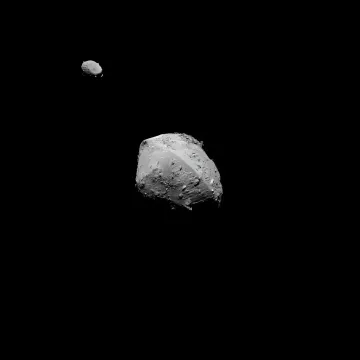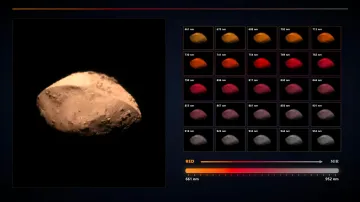
The European Space Agency (ESA) has published the first detailed images of the aftermath of NASA's DART spacecraft impact with the asteroid Dimorphos, a moon of the Didymos binary system. The images were transmitted to Earth by the Hera research spacecraft, which has arrived at the system and conducted initial reconnaissance. A composite image assembled from 11 frames taken by the Hyperscout-H instrument on November 6 from a distance of about 30 km reveals a massive crater, an altered shape of the celestial body, and an entire cloud of debris near the binary asteroid.
Stadium-Sized Crater and Lost Shape
According to the Hera mission science team, the impact of the DART probe, which took place on September 26, 2022, at a speed of about 22,000 km/h, left a crater on Dimorphos stretching across almost the entire width of the asteroid. Lead scientist Patrick Michel noted that the resulting depression is comparable in scale to a sports stadium and matches the size of Dimorphos itself, which has a diameter of about 151–152 meters. The impact not only carved out a crater but also changed the overall shape of the celestial body and disrupted its previous rotational stability.
Didymos Stable, Dimorphos 'Wobbling'
Initial observations by Hera showed that the larger asteroid Didymos continues to rotate on its axis just as it did during the DART flyby in 2022. The smaller Dimorphos, by contrast, lost its previous stability after the collision and now noticeably wobbles as it moves along its orbit. Dimorphos' orbital period around Didymos has shortened by approximately 33 minutes, which specialists estimate significantly exceeded the experiment's initial predictions.
Debris Cloud and Navigation Risks
During initial reconnaissance, Hera discovered hundreds of multi-meter-sized boulders surrounding the binary asteroid. Before combining the frames, researchers digitally removed the bright images of Didymos and Dimorphos to get a better look at the debris. Scientists suggest these boulders may have been ejected from Dimorphos during the DART impact or preserved since the moon's formation. The debris field complicates spacecraft navigation and the deployment of cubesats; however, due to the extremely weak gravity of the asteroids, the spacecraft, cubesats, and surrounding boulders move relatively slowly—at about 12 cm/s—reducing the risk of a sudden high-speed collision.
Juventas and Milani Cubesats
Over the next six months, Hera will approach both asteroids and deploy two small cubesats: Juventas and Milani. Their task is to attempt a landing on Dimorphos and investigate its composition, mass, and internal structure. The deployment of the cubesats is scheduled for January 2027.
Significance for Planetary Defense
The Didymos–Dimorphos binary system itself poses no threat to Earth. Nevertheless, studying Dimorphos has direct practical significance: the data obtained will help more accurately predict the results of future missions to deflect potentially hazardous asteroids. Because small celestial bodies behave differently than objects on Earth due to weak gravity and low surface cohesion, detailed information about their properties is essential to understand how an asteroid will respond to an impact and whether it will change its trajectory.