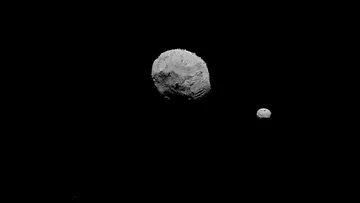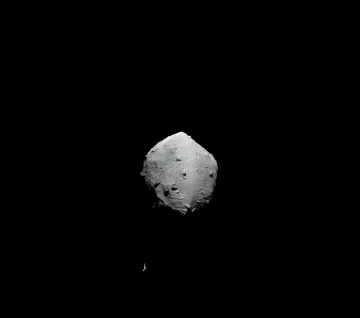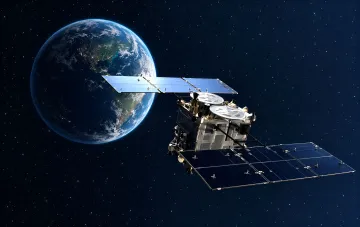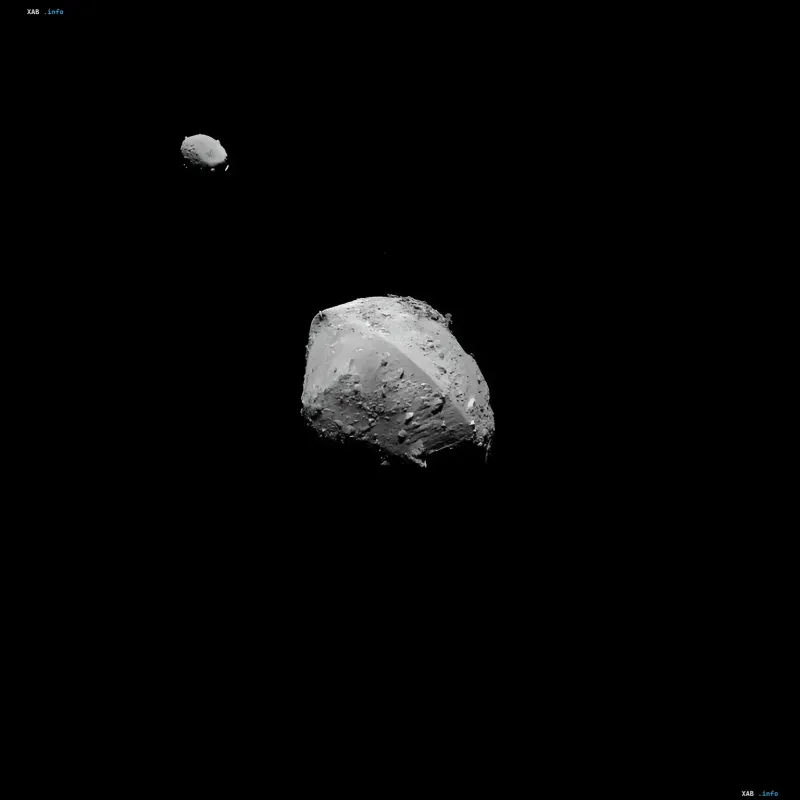
On November 25, 2026, the European Space Agency's (ESA) Hera spacecraft reached the Didymos-Dimorphos binary asteroid system following a two-year journey. Upon the probe's arrival, ESA released the first images obtained during the mission. As a reminder, in 2022, the smaller asteroid Dimorphos was the target of NASA's DART (Double Asteroid Redirection Test) mission, which aimed to see if a potentially hazardous celestial body could be diverted via kinetic impact. Now, the European probe has provided the first in-situ look at the aftermath of this experiment.
A crater spanning the asteroid's width
At the impact site, a crater the size of a stadium was discovered, spanning the entire width of Dimorphos. Additionally, one side of the asteroid was found to be flattened, and it is now rotating chaotically around the larger body, Didymos. The DART mission was the first successful test of an asteroid deflection technology using a kinetic impactor; the approximately 570 kg spacecraft struck Dimorphos at about 22,500 km/h, reducing the asteroid's orbital period around Didymos by approximately 33 minutes. However, observations from Earth could not determine the exact physical changes that occurred on the celestial body itself.
All scenarios came true simultaneously
Hera utilizes several instruments: the monochrome Asteroid Framing Camera, the Hyperscout H multispectral camera capturing 25 bands simultaneously, and the TIRI infrared thermal imager developed with participation from the Japanese agency JAXA. According to scientists, various consequences of the impact were initially debated, such as crater formation, structural deformation, or a lack of noticeable changes. The new images revealed that all these processes occurred simultaneously.
Uneven changes and new boulders
The changes were found to be non-uniform: in other parts of Dimorphos, the boulder fields look much as they did in the 2022 NASA images, meaning no massive surface restructuring was detected there. Another surprise was the discovery of hundreds of previously unknown boulders, several meters in size, orbiting the asteroid pair. Scientists will have to account for these during future close approaches.
Ongoing work and plans for 2027
Hera is currently operating at a distance of approximately 25–30 km from the binary system, moving along special rectangular orbits at an average speed of about 12 cm/s. In December 2026, the spacecraft is scheduled to approach to within 13 km to capture higher-resolution imagery. In January 2027, ESA plans to deploy two small CubeSats: one of them, Juventas, will attempt to probe the asteroid's internal structure for the first time using a low-frequency radar, while the second, Milani, will study the surface material and surrounding dust.
Why this matters for planetary defense
The Hera mission is designed to help understand not only how much a kinetic impact can alter an asteroid's trajectory but also the specific physical processes involved in such a collision. This is crucial for turning the success of the DART experiment into a well-understood planetary defense technology, the effectiveness of which can then be assessed for various types of celestial bodies.